Since I was tagged on a response to that “big data” story, here are my thoughts about it. First, the “article” linked in the original post is essentially an advertisement. It’s hosted by a firm (Bernard Marr & Co.) that sells services based on big data. It links to a page where people can buy a 2016 book written by the titular head of this company, so my guess is that the article was written in advance of the book’s publication.
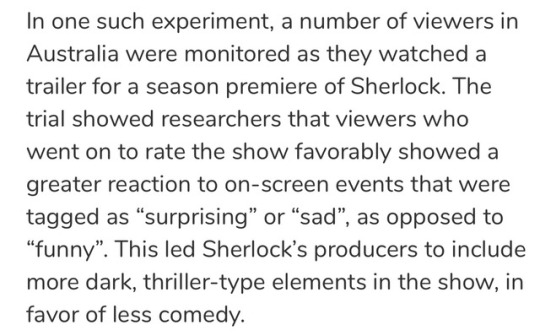
Both the article and the book make two claims about Sherlock: (1) that the BBC tested the use of facial-recognition software in several countries around the world, on various BBC content; the Sherlock test was in Australia, and the content was “a trailer for a season premiere”; and (2) that the results of this test in Australia “led Sherlock’s producers to include more dark, thriller-type elements in the show, in favor of less comedy.”
The first claim is easily fact-checked. The 2016 book that they’re trying to sell [link to relevant chapter] cites only one source the information about the trials: a Wall Street Journal article published in 2015 [link], which doesn’t mention Sherlock at all.
There are a handful of articles on the topic of BBC and these software tests, including this one in The Independent [link]:
Rather than tailoring new programmes to match the results of the
experiment, the insights would be used to guide viewers towards more
shows they might like, informed by their conscious and subconscious
reactions.
And indeed, the content shown in the Australian test was the trailer for The Empty Hearse. The point was to determine whether it would entice people to watch the show. These are remarks from client lead Erik Lonnroth at CrowdEmotion, the company BBC hired to conduct this study:
He said: “It’s Interesting to understand not just how an ad affects
you when you’re invited into a focus group session on a Sunday
afternoon, but [when] you’re at home and you’re flipping the channels.
“You’re on your laptop and something comes up – it’s that natural
environment, where you don’t have your guard up and you’re not going to
expect questions. It’s a natural laboratory.”
Lonnroth added that, in future, emotion detection could be integrated into iPlayer to help users decide what to watch next. [link]
I could not find any article that stated BBC had used these findings to tailor content within a show, or that they were even interested in doing that. In other words, I could find no support for the second, uncited claim in the “big data” article currently being discussed.
TL;DR: I could find no evidence that the BBC is even interested in tailoring the content of its shows to satisfy viewers’ unconscious reactions. The BBC did hire a company to find out if its marketing was effective; they may have used the findings of the study to alter marketing, but we don’t know whether they did or not. I could find no evidence that BBC used the findings of that study to alter the content of Sherlock—that claim appears to have been made only by a company that is trying to show the power of big data because it sells big data. My guess is that this company also wants its clients to associate it with large, respected companies like the BBC and others it cites as “case studies”.
Mofftiss sold their stories & their integrity for $$$ due to “data” Explains S4 a LOT actually.
Just like ACD sold his stories and integrity for £££ (for literal decades) ~ give the public what they want! That’s all! Interesting parallel @devoursjohnlock
Love how this fulfills so many of the same parts of the myth of the uncaring creator (ACD), which Moftiss have worked so hard to recreate:
Author who only wants the £££
Author led by public appetite
Author who therefore doesn’t care about consistency of tone/character
Unwilling author drawn back in to the project by powers (publisher/BBC/Big Data + £££) beyond their control
I think the big difference here is that, YES ACD decided to continue writing the stories due to demand and because the money was good. I don’t think anyone is arguing that he continued writing due to his love of the material.
The difference here is that he did not butcher his characters and completely change the direction of stories to do so. Sure he kept writing, but he didn’t go “oh some people like horror, I’m going to add a secret xman sister and a murder maze.” He didn’t turn John into a rage monster or suddenly make Mary the narrator of the story.
I don’t believe for one second that this is all faked so they can pull some real life Reichenbach of the series. And from ratings and reviews, S4 was a long ways away from “what the people want.”
I do believe they wanted to make BBC Sherlock a brand, and have done so. You too can go solve a mystery with Sherlock Holmes in their escape room if you pay enough money.
Illustration by Gregory Orloff for “The Adventure of the Blue Carbuncle”, Wonders and Workers (Basic Reading and Literature Vol. 2), Chicago: Scott, Foresman and Co., 1951.
Sherlock Season 4 : a story of a man with special abilities, an annoying powerful brother and a super powered psychotic murder sister who their parents kept secret.
Thor Ragnarock : a story of man with special abilities, an annoying powerful brother and a super
powered psychotic murder sister who their parents kept secret.
Both featuring Benedict Cumberbatch, and only one of which is now believable.




 Sherlock Fandom Archive