Some times experiments don’t work out. Sometime big projects include mistakes and it takes a lot of compromises to satisfy the real goal. So was the case with The Six Thatchers.
To a room of ~100 people, Rachel Talalay explained something of the complicated backstory to the first episode of Series 4 and shared with us a little of the amazing footage that had to be left on the cutting room floor.
In Mark Gatiss’s initial script, the story was going to be told with a complicated chronology. The story was supposed to start somewhere in the middle, with flashbacks inserted into scenes. This show has played with chronology before, but this plan was more ambitions and experimental than previous episodes. In the spirit of Sherlock’s cinematographic ingenuity, Talalay decided to demarcate these flashbacks with fantastic transitions in and out of the scenes into which they were inlayed.
The filming proceeded with this non-chronological order of scenes, but when the material was assembled in a temp edit, it became apparent that the narrative didn’t really work. Talalay had her doubts about how it came together, and Moffat and Gatiss made the call to change the sequence to the straight forward chronology we saw broadcast. Talalay took pains to explain that the switch was necessary for the sake of the story and that no one was at fault for how the experiment failed. They took a risk together and these things don’t always pan out.
The choice to reorder was the right one, but it was also a very difficult compromise for two reasons. First it changed the purpose of many scenes, and with no time to reshoot they had to work out new criteria to determine the best takes to make a cohesive narrative from what they had. Second, it meant abandoning these amazing transitions that were in and of themselves creative and technical acheivements that each took days to prepare and shoot.
It was these transitions that Talalay shared with us at Sherlocked USA 2018. They will never be released, so here are my descriptions of the transitions she shared. Some of them involve scenes that weren’t part of the final edit at all. I’ve done the best I can to describe what I can remember from seeing these only twice.
1. In and Out of Cars This seems to be on the way to the first case with Greg, on the way to the WELSBOROUGH HOUSE. John, Sherlock, and Greg are in a taxi in the middle of the day. Greg says “So how long has it been then” and John replies “Three months.” Sherlock rises from his right-forward facing seat and steps out of the passenger door into day light. The camera approaches his back until we only see the coat. Camera recedes and it is night. Sherlock steps back into the right passenger seat while typing in his mobile and Mary is wheezing in labour. The camera pivots to also catch John at the steering wheel, as seen in the show. There is another transition back to the original taxi shot and John repeats “About three months.”
2. Walking through Doorways: As Greg, Sherlock, and John approach the door to the Welsborough House, Greg says “…We thought we’d never see you again.” Sherlock replies “You weren’t the only ones.” As Sherlock steps through the doorway, he pass into the room where he and Mycroft are interrogated by Sir Edwin and Lady Smallwood. He sits down and takes off his coat. The scene that followed was the one used to open The Six Thatchers.
At then end of this scene, Sherlock says “Because I love it.” and walks out the door and back into the WELSBOROUGH HOUSE.
3. To and From the Christening: John is looking at bus shelter and a bus goes by and reveals that he is wearing church clothes at the Christening for Rosie. John says to Sherlock something along the lines of “You could come visit Rosie” and Sherlock replies “The conversation would be a bit onesided.”
Another shot of Sherlock approaching the camera down the aisle, framed by the arches of the church. I’m not sure if this transitioned to another scene.
4. Through the Mirror: In the sceen where Mary finds Sherlock in the Moroccan hotel, the shot begins with her standing by the table looking accusing and Sherlock sitting on the floor crossed-legged. Sherlock gets up and walks towards a mirror by a curtain in the back of the room. In the curtain we see a reflection of Mycroft’s underground office. Sherlock walks past the mirror into the scene where Mycroft begins by reciting the wikipedia article for “Agra”
When that scene ends, Sherlock rises from his seat and walks back to the mirror to pass back into the Moroccan hotel room and sits down on the floor again to pick up the conversation with Mary.
5. Lastly, one of the magical transitions that were kept was Ajay remembering his torture and then falling back onto the carpet. Apparently the sequence was initially filmed as a single shot, with four sets lined up side by side. Like wow.
***
I can’t attest that these are perfect descriptions of what was in these shots, and I know I’m missing some details. If anyone else remembers other things, please add them in.
Talalay had every reason to be proud of these transitions. They were breath taking (my descriptions do not do them justice!) and the audience gasped and clapped through the three minutes of footage that she shared. I am so sorry they had to make the compromise of removing these. I understand that it was deemed necessary, and Talalay was very clear that she agreed with the decision to change the order of the scenes, but it is a tragedy that we lost these beautiful tricky transitions.
So now please someone explain how johnlock somehow became TFP.
And as I am typing this it occurs to me, johnlock literally IS -still- the final problem.
A Study in Pink appreciation week! I haven’t given up on it! Being noisy about tiny unnecessary details is absolutely my cup of tea. I finally found time for a rewatch and drew some of my favourite details. I had more listed, but these are all I drew.
1. This silhouette amuses me.
2. First cab ride together, and from when Sherlock gets to explain about Harry’s phone, John just… stares at him with a gaping mouth. JOHN WATSON, YOUR FACE. Evidence number one:
(A Watson-Lestrade hybrid is what this drawing is.)
And two:
And he just doesn’t move. JOHN WATSOOON.
3. Sherlock’s hand gestures on the ‘rache’ crime scene (or just about anywhere on that matter). No excuses for that one, I am a sucker for beautiful hands that move beautifully. You need to watch the scene of course to get the best bits.
4. Mycroft’s protectiveness of his brother. They are adorable.
Mycroft examined an unamused John’s hand. I didn’t remember this scene. Dear creators, do tell us more about Mycroft’s ring.
5. Sherlock asks John if he could borrow his phone. He just holds out his hand, John puts it there, and Sherlock does nothing but fondle the phone between his hands for a moment while meditating and then hands it over again. I love this scene so much.
6. “Nothing, just… “Welcome to London.”“
That quote and the exchange of looks!
And I’ll leave this here:
7. Sherlock’s ”…….oh.“ face after John says he doesn’t need to use his imagination thinking what his last words would be, that I completely managed to ignore the first time. He just looked so sad and sorry and moved and touched by John’s vulnerable moment right there. SUCH A GOOD MOMENT.
As my research into various Sherlockian topics and themes grows deeper, I find myself searching through the catalogs of special collections at an assortment of key libraries throughout the world. Below is a wish list of sorts detailing a few of the libraries I hope to visit some day soon:
Search the ACD Collection at the Toronto Public Library here.
“The Toronto Reference Library has one of the world’s foremost collections of library materials devoted to the life and work of Arthur Conan Doyle. Much of the collection, of course, is devoted to Doyle’s most famous character, Sherlock Holmes. The Collection is housed in a room evoking 221B Baker Street, where people can browse along open shelves in a manner unusual in a special collection.”
Search the Sherlock Holmes Collection at the University of Minnesota here.
“The Sherlock Holmes Collections at the University of Minnesota Libraries constitute the world’s largest gathering of material related to Sherlock Holmes and his creator Sir Arthur Conan Doyle. The Collections consist of over 60,000 items including books, journals, and a wide variety of other forms through which the transformation of the Holmes character from the printed page to a cultural icon can be traced.”
[Book jacket mockup for Profile by Gaslight by Frederic Dorr Steele.]
“This is a synthetic collection consisting of manuscripts, typescripts, correspondence, an undated notebook, financial and legal documents, and a photographic portrait. The manuscripts and typescripts comprise plays, stories, chapters from novels, poems, essays, and drafts of a Sherlock Holmes play by W. H. Gillette. The correspondence consists of letters from the author, dating from 1881 to 1930. There are 1,192 items in total.”
Located in the Berg Collection of English and American Literature.
* Portsmouth History Centre (Central Library): Arthur Conan Doyle Collection – Lancelyn Green Bequest.
“The Sir Arthur Conan Doyle Richard Lancelyn Green Collection is one of the most wide-ranging in the world. It includes first editions of books, related letters, film and television memorabilia, as well as Richard’s recreation of Sherlock Holmes’ Baker Street study. Richard collected items with some connection, however obscure, with Sherlock Holmes – from matchboxes with Sherlock Holmes on them, to adverts in magazines and even copies of the Radio Times with listings of related programmes.”
“The Trust is a special part of the Baker Street Irregulars, the literary society dedicated to the study of Sherlock Holmes and Dr. Watson. The Trust is designed to collect, archive and preserve historical documents for the study of Sir Arthur Conan Doyle, Sherlock Holmes and Dr. Watson, the Victorian world and the individuals and organizations like the BSI that have devoted themselves to such studies. The Trust has a special interest in preserving materials relating to the history of the BSI, its members and friends.”
Further information about the BSI Trust Collection at Houghton Library can be found in the For the Sake of the Trust newsletter (pdf).
“The Starrett Collection at Northern Illinois University Library’s Rare Books and Special Collections began as a modest collection of Chicago Renaissance material many years ago. Items in the collection have been purchased over the years by the library or donated by collectors and other libraries. The collection consists of Starrett’s novels, bibliographies, essays, poems, correspondence and letters, biographies, autobiographies, and miscellaneous odds and ends such as greeting cards and book plates.”
“the world’s largest gathering of material related to Sherlock Holmes and his creator Sir Arthur Conan Doyle“ at the University of Minnesota! Has anyone physically been there and seen the collection, or is it closed to the public and only viewable online?
I tried to see the NYPL collection when I was there but it required academic credentials. Does anyone know how someone without paperwork can see any of these collections? Do I need to kidnap a librarian friend?
Speaking as both an academic and a librarian-in-training, you could probably get away with calling yourself an “independent scholar” or something similar as long as you can find someone with aca-credentials to write you a letter of recommendation. My master’s advisor, who has written most of those letters for me, said it basically amounts to “I trust this person and they will not steal or destroy your materials.” As an academic, those letters were not always necessary for me – I’d often bring them into the archive/library and be told “Oh we don’t need that”, but they would probably help if you don’t have those credentials yourself.
ALSO: it will really help if you plan your visit in advance. Even most academics will get turned away if they show up to the library/archive without advance notice, particularly if the stuff you want to see is kept off-site. Email the person in charge of the collection, explain what aspects of it you’re interested in and when you’d like to see them, and that should help your chances a LOT.
Also2: I’ve been to the collection at Portsmouth and it is FANTASTIC. If you’re ever in the area and can get into the archive, I highly recommend it. My thesis wouldn’t have been possible without the help of those archivists.
(just ignore the “click” sounds, they’re coming from the keys of my electronic keyboard and my phone was too close to it while recording)
TFP is so fakefakefake lalalaa~ ♪
I have no idea if someone’s already pointed this out but let’s just begin:
Funny coincidence. I was looking for a song to play on the electronic keyboard. It’s been a very long time since I last played (and I never really managed to use both hands at the same time *laugh*) so it had to be an easy one. I stumbled upon one that was called “Rousseau’s Dream”, listened to the first few notes and was like: Wait! You know that tune!
Turns out it was the tune of Eurus’ song.
And here we go:
The original tune is part of the French opera “Le devin du village” (The Village Soothsayer) by Jean-Jacques Rousseau.
Okay, I won’t go into detail about how the infidelity plot of the opera and Sherlock series 4 may be connected. What I find the most interesting is the soothsayer the protagonists seek advice from.
Remember what Mycroft said about Eurus?
“There is, in this facility, a prisoner whose intellectual abilities are of occasional use to the British government.” “She predicted the exact dates of the last three terrorist attacks on the British mainland after an hour on Twitter.”
This can’t be a mere coincidence. It just can’t. The universe is rarely so lazy.
But it gets better! Because this was just the original tune.
In 1819, Johann Baptist Cramer published a version of the tune – and this one’s much more similar to Eurus’ version – under the title “Rousseau’s Dream”. Rousseau’s. DREAM! (I burst out laughing when I read the title since I’m still convinced that not everything we saw in series 4 is real and that TFP, at least, takes place in Sherlock’s mind palace or is John’s TAB.)
But there’s still more!
It is also the tune of “Go Tell Aunt Rhody”, an American folk song. It’s about the death of Aunt Rhodey’s goose. A goose that died in a mill pond.
(And can we please talk about how similar “Aunt Rhodey” sounds to “Uncle Rudy/Rudi”?!)
And this still isn’t all!
Because THIS.DAMN.SONG plays heavily in “Resident Evil VII”, a survival horror video game!
And what is it about?
“The game proper takes place after the events of Beginning Hour [A/N: the teaser demo], which ended with the murder of a three-man TV crew by the possibly-infected Baker family members Jack and Mia. It features a new protagonist named Ethan Winters, a civilian who offers fewer combat skills than most previous Resident Evil protagonists. Ethan is searching for his missing wife, Mia, which leads him to a derelict plantation mansion, home of the Baker family.” (source: http://residentevil.wikia.com/wiki/Resident_Evil_7:_Biohazard/plot )
Now, listen to the song:
“I was raised in a deep, dark hole, A prisoner with no parole, They locked me up and took my soul, Shamed of what they’d made.”
asdfsgdsjashfkghjkljdsfkl
I can’t … I …
They could have easily composed a new tune for Eurus’ song. But they didn’t. They used this one! And all this can’t be a coincidence! (Because that would be one helluva one!)
This … TFP has to be fake/Sherlock’s mind palace/John’s TAB/etc.! It has to!
Tagging some people under the cut, I hope you don’t mind.
Love this! Being from the rural south in the US, I grew up hearing / singing “Go Tell Aunt Rhody” so Eurus’ theme has always been familiar to me. What I didn’t know was all the rest of this and the horror game tie in. Just. Wow. I need NO CONVINCING that all of Series 4 remains in Sherlock’s mp (and if we get a secret 4th ep or series 5) that that reveal will be the rug pull they’ve been talking about. But it continues to be gravy to keep finding all these things that back up my thoughts on this theory. EMP lives on.
What an amazing find, @sockenpuppe! This cannot be a coincidence, especially since the song appears in so many versions. And you know what this reminds me of? The Appledore theme from HLV which is very similar to the “Cold Song” from Henry Purcell’s opera “King Arthur”. I have written a little meta about it: X.
So there is a precedent of Arnold and Price using a piece of Baroque music as a template for a key theme in Sherlock.
And remember the convo we had about Bach! Btw, when I read your cold song post, I was reminded of eldritchhorrors fic with the same name, never finished but left in 2013, before shooting for s3 even began. That story describes Sherlock playing the Chaconne… I wonder when this piece will feature in the soundtrack…
I know I promised that I would update on the first post in two weeks a loooooooonnnnng time ago, but here I am updating it after a month and a half, so sorry about that.
If you haven’t seen the first part of the post, here’s the link: Part 1
This part of the post will add in more things such as the artifacts from the exhibit I forgot to take pictures for the first time I was there, as well as the Arthur Conan Doyle Collection room! 😀
Introduction to the TV/Film adaption section:
Just a little history.
Granada Series Adaptation
As I mentioned last time, I forgot to take pictures for the Granada Series, but! I took a second trip there and took more pictures! So here we go:
Very iconic picture:
(^^ I think the second picture is from the later version?)
Two pictures of Holmes by himself:
*whispers* I’m straight for Jeremy Brett 😉
RDJ Poster for American Library Association
Yes, I was confused too until I read the description:
Italian Poster for the Seven Percent Solution
Pretty.
Theatre Programmes
(Here’s two that I’ve posted last time, just to keep it here to have the post organized):
Also there was this:
??? I… uh… I don’t know how to feel about this???
Our beloved BBC Sherlock Manga Series
Interesting to see all the different versions of covers. Besides the first one on the left, I’ve never seen the others.
(Sorry that I forgot to take a picture of the info, but I assume that we all know enough about BBC Sherlock series)
Arthur Conan Doyle’s Letter
If you couldn’t read the words on the paper:
“In this letter to his editor of the Strand Magazine, Conan Doyle expressed the belief that ‘Holmes must preserve his dignity’ if he were to appear in an advertisement. Since that time Holmes has appeared in several hundred advertisements for a wide variety of products. In terms of preserving his dignity in the process, the results have been mixed.”
*cough* mixed in deed *cough*
Here’s ACD’s letter in MANUSCRIPT:
Simply gorgeous and graceful handwriting. ❤
The next update is on the Arthur Conan Doyle special collection, keep an eye out if you are interested. Let me know if you want to be tagged or untagged for updates!
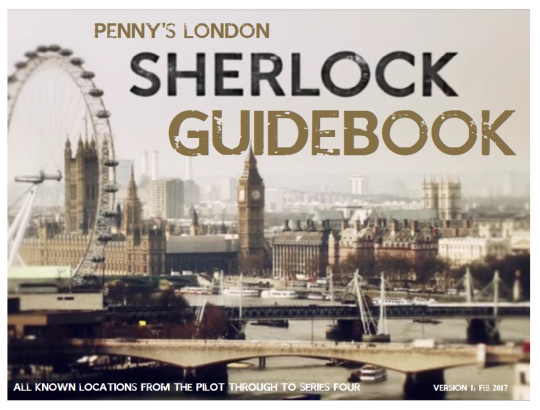
The fruit of hundreds of hours of research, tramping London, photographing, screencapping and cursing PowerPoint, it is here!
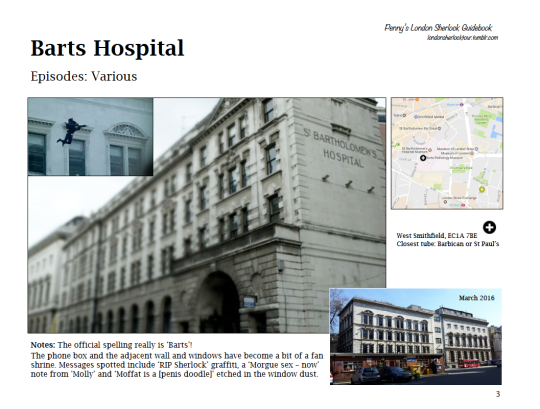
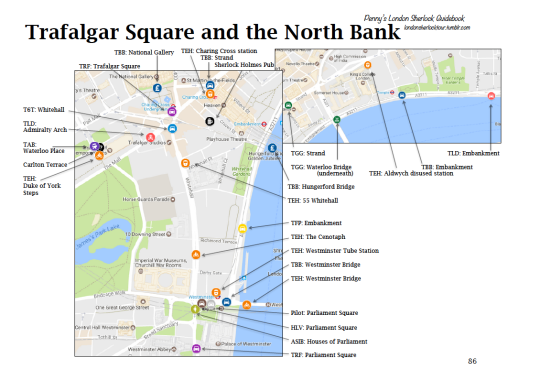
The guide contains maps showing how to find every known BBC Sherlock location in London, with screencaps and text identifying where it featured, and contemporary photos to show what it looks like now. There are also some special sections such as how to follow the ASIP taxi chase in order, and area maps to help you devise local mini-tours if you like.
I (@pennypaperbrain) have lived in London for 20 years, and this guide grew out of showing fandom friends around, first the obvious places and then some not so obvious. Photography is by the indispensable @sincerely-chaos.
This is version 1 so I’m sure there are many improvements and refinements that can be made. Please email londonsherlocktour at gmail dot com if you have feedback, or squee. (You can also use tumblr of course, but tumblr eats asks). If you end up using the guide in London, it would also be particularly cool to have stories/photos to feature on this tumblr.
NEW on The Baker Street Babes: Book Release: Femme Friday
We are incredibly happy and proud to be able to announce the publication of our essay collection!
What started as an act of resistance – a weekly post on Fridays on our tumblr to celebrate – rather than mock and put down – women became something we greatly enjoyed doing, and so it grew into a series. This volume is a collection of these essays on the women in the Sherlock Holmes stories as well as in adaptations and pastiches. We tried to include as many ladies as possible, though we are aware that we missed the likes of Mrs. Cushing from “The Cardboard Box,” Nancy Barclay from “The Crooked Man,” Emilia Lucca from “The Red Circle” as well as the ladies from “The Greek Interpreter” and “The Retired Colourman”, and a few others. However, we have assembled quite the collection of essays on awesome ladies, so we beg forgiveness from the fantastic ladies we did not manage to include.
Once the idea to publish the essays in a book started to form, we opened a call for further essays on our social media sites – which resulted in the 33 essays in this collection.
Trying to figure out how to best navigate formatting and figuring out the quirks of self-publishing was a steep learning curve – and it continues – as we are working on an epub version of the content. In the end, we decided to publish with two different companies, as shipping costs would always be horrendous for one continent or another. We are now selling the book on Blurb.com (US market) and Lulu.com (European market).* Since the books have several gorgeous images by Merilyn Paugus, we wanted to honour her work as well, so we created both an affordable black and white version of the book, and a slightly more fancy one with colour images.
You can find the US versions here, and the European versions here. They are only very slightly different in format, and Lulu allowed for a title on the spine, whereas Blurb did not, but essentially they are the same. Within a couple of weeks, the book should also be available via Amazon and Barnes & Noble.
All proceeds of the sales are used to cover the maintainance costs of our website and podcast hosting sites.
We would like to thank every one of those amazing ladies who offered to contribute to this project. Femme Friday resonated with a lot of people and this collection is very important to us as Sherlockians, and as women.
*We dearly hope that shipping to Africa, South America, Asia and Australia won’t be too expensive!
BBC Sherlock's episode titles inspired by Sir Arthur Conan Doyle's original stories and novels.
*A Study in Scarlet -- A Study in Pink
*A Scandal in Bohemia -- A Scandal in Belgravia
*The Hound of the Baskervilles -- The Hounds of Baskerville
*The Adventure of the Empty House -- The Empty Hearse
*The Sign of Four -- The Sign of Three
*His Last Bow -- His Last Vow (x)




 Sherlock Fandom Archive