So we know that basically every minor character in this show is a mirror for another character, right? Well I was watching teh again recently and it hit me: the father and daughter at the bonfire represent John’s father and sister.
Let’s take a minute to remember these folks at the bonfire: A young blonde girl (wearing red aka John’s color?) doesn’t want her father to set the fire because Guy Fawkes (who admittedly is dressed a bit like John with the plaid shirt) “doesn’t like it.” She knows this isn’t right.
The father sets the fire anyway.
The daughter is the first to notice that John is actually in the fire. She’s the one who reacts the most strongly out of anyone in the crowd. No one in the crowd tries to pull John out, including the father, who instead holds his daughter back.
So what do we know about John’s family? We know from a deleted bit of dialogue included in Sherlock: Chronicles that John’s mother is dead (x). We know that he has one sibling, a sister, who is gay. We can deduce from some subtextual hints that John’s father is likely a conservative, “old-fashioned, traditionalist,” homophobic, military man (x).
So John, unseen and unable to speak, closeted and invisible, is nearly burned alive by his father who doesn’t realize how much he’s harming his son.
Nice touch with the rainbow flare.
John’s father’s homophobia and intolerance for gay/bi people is killing John and his father doesn’t even know it. His father thinks what he’s doing is acceptable. Meanwhile John’s gay sister understands completely what is happening and is horrified. This makes John being dragged out of the fire by Sherlock so much more meaningful. No one in the crowd tries to save John, no one has done enough to prevent John from being harmed in this way or tries to stop it. John and Sherlock’s love for each other will save them both, even when no one else will.
I haven’t have time to read the thing yet, but I’m seeing a lot of people talking about the relationship between the blog and the show in S4, and I thought it might be a good time to mention that Culverton Smith’s hospital wing probably opened for business the day of or the day after John’s stag night.
I think there was a lot of discussion early on about this date being 20 July, 2044, but it’s really 20 July, 2014 (not enough room for two 4s there).
The following day, John wrote up the Mayfly Man case, describing his “quiet, civilised evening” with Sherlock.
So civilised that it led him to create a persona based his darkest vision of himself, I guess.
Theoretically, there may have been a lag between the courtroom deduction scene in TSOT and John writing this post, but he needed no additional information after that scene to do it, so I’m betting that stag night occurred 19 or 20 July, 2014. Whether or not “the show is the blog”, this is support for Culverton Smith being a creation of John’s mind.
i’m sorry, but…. WAIT A MINUTE. JOHN’S DARK MIRROR, WHOSE ACTIONS TOWARDS SHERLOCK (the scene in his hospital bed) ARE FULL OF SEX/VIOLENCE PARALLELS, POSSIBLY WAS “CREATED” (his hospital is his castle indeed) AFTER JOHN’S STAG NIGHT?
In this TST scene there is (an image file of) a blog post about changing Rosie’s nappies that wasn’t supposed to be there at the time because Mary is in this same scene, still pregnant.
Just like Sherlock deduced in the Great Game (Fourth Pip/Fourth Season) that the painting’s a fake because the Van Buren Supernova wasn’t supposed to be there at the time it was said to be painted.
@chrysanthemumsies what an amazing presentation! Of course everything was discussed for many times, but it’s so good to see it as a presentation!
May I point to my favorite parts?
1. «Sherlock begins narrating a tale about the Appointment in Samarra, he’s setting the stage himself» – I can’t agree more, TST is definitely Sherlock’s POV/“creation”/narration for me.
2. I’ve finally sort everything through about repeated scenes!
Two scenes with John on the bus. They are the “same”, but in the second scene we see the continuation of the previous one, and that’s where the lie starts! It means, as you wrote, John didn’t flirt with E and didn’t accept her phone number.
Same with John texting E. The lie starts when we see their texts on screen.
They deliberately filmed these scenes separately (when John gets off the bus the second time, the man who gets on the bus holds his newspaper differently + there’s another car on the background) (Mary’s “Mommy’s coming” and “I’m coming” will bother me for eternity!). There have to be reasons. 100%.
(I love TST and its fuckiness so much, I could rambling about that for hours)
Haha thank you very much! Obviously this was made before The Lying Detective came out so you can see the Fresh Hell we were in.
Yeah honestly the thing that baffles me the most is the scene inconsistency whenever they’re talking about horror movies in bed (WHICH IS A META IN ITSELF). Like the scene ends BOTH times with John looking at a text, and the only difference is in the NEXT camera change. Why the fuck did they use two slightly different versions? What was the point? Don’t they know how crazy their fanbase is? Same with the bus.
Yeah I love the narration point as well. This whole episode was set up to show us it’s fake. So either Moftiss missed an opportunity that was practically gift wrapped for them to take, or there’s something more at play…
YEP exactly @221bloodnun – just a few little things to add:
The person that applies wallpaper, i.e. Arwel, is called paperhanger, which in slang: one who passes worthless checks, i.e. The Blind Banker. I’ve addressed (partially) the possible connections between TBB, spaceships and the timey wimey in the stoppage time post.
The reason we’re given multiple pov’s and countless intertext: the stories of Holmes and Watson have always been bigger than their lives (not by choice perhaps, but “heroes” nonetheless), “your life is not your own” can be taken… literally. The artistic and cinematic techniques used to express a specific genre or a movement (-ism) are simply… semantics; all the theories seem right but only in parts is because they are. ACD did it with the form of his art, which is writing; Mofftiss is doing it with their form of art, which is cinema. Why brought Brecht’s theatre into the mix? Well, who was the dramatist of ACD’s contemporary with a connection to Holmes/Watson and 1895? Oscar Wilde’s consistent presence in Sherlock is not for shits and giggles, reading the subtext is only the beginning.
I know I kept shouting into the void about this, but when the 4th wall falls, it is no longer just about these characters lives, but the reality of their time. Sherlock Holmes and John Watson cannot exist in the 21st century without them addressing the trappings of Victorian fin de siècle, what ACD was really doing with Holmes/Watson stories, and everything that came after; i.e., Sherlock and John’s “back story.” I tend to believe Mofftiss when they said Johnlock wasn’t what they were doing – because it’s never the question of if, but why it remained hidden. Series 4 in many ways provided a road map to seek the evidence – all we need to do is dig deeper, and look harder.
And now I am sitting here thinking about the concept that Hitler was a paperhanger, because of the Cardinal Mundelein speech of 1937. @darlingtonsubstitution From the meta mentioned: “German Expressionism was the result of WWI, and several
Rathbone/Bruce Holmes films entailed them fighting the Nazis, which is
where Moffat and Gatiss have been hinting we’re headed next. “And we
have joked about doing one in black-and-white where they fight the
Nazis. So maybe that’s what we’ll do.” – Radio Times“ As for the life is not your own speech, it’s also related to another film for which I updated the old spheres and loops meta you knew from back in March, Stay.
YES in that Gatiss podcast interview, he said something along the line that “eras are falling all around us” – we talked about the whole political aspects of Sherlock that weren’t really noticeable, but suddenly visible after series 4? But instead of the 40s, I’m guessing we’re heading closer to the present in the timeline, perhaps the events that led to 1989, Project Hound, and Carl Powers. BTW did you watch Against the Law? I think it’s very relevant……
– or “Sherlock is learning how relationships work”
…remeber the time when Sherlock suddenly popped up during a quite serious conversation between John and Mary in Marocco… seriously, has he been there the whole time listening, never visible before, even when we were shown a big part of the room before
the room
pop-up Sherlock
But look at that above picture… look at the mirror
It is literally John standing between Sherlock and Mary!! In the mirror!
And this the same moment when Sherlock literally says the same thing as Mary said just a second ago…
And this all happens after that moment when John talked to Mary the same way he once talked to Sherlock…
Only this time our pop-up Sherlock comes to an essential conclusion on his mind stage:
and he’s really trying to work on things because he learns from it
So…. what was Mary’s dying scene? The way Sherlock wishes it had happened, when he was shot? In John’s arms? It wouldn’t have been TRF, because Sherlock knew he would be back. Pretty sure. But when Mary shot him, he wasn’t sure he’d survive, and he went looking for John in his Mind Palace, but never found him.
There’s a recurring joke in Sherlock
about it “never being twins”, one of the many unfired Chekhov’s
guns. Now the smart and lovely @patiencegrenade has pointed me towards
the possible answer. Stay with me, please!
A Canadian show called Murdoch
Mysteries, about an 1890s detective solving crimes (sounds familiar,
anyone?), had three episodes which featured Arthur Conan Doyle as a
character. Whenever he visited, he and the main character detective
Murdoch had some serious Sherlock-Watson vibes.
In the episode Belly Speaker, which
aired in 2008 (so two years before ASIP), Doyle makes his second
appearance.
The episode starts when an alcoholic
dad (cue John Watson-reference) gets murdered. Murdoch and Doyle
enter the crime scene and open the closet, where the victim’s son
Harcourt and his puppet are found hiding. The man is a ventriloquist and
his puppet’s name is… Mycroft. I wish I was making this up.
Harcourt quickly confesses, but Murdoch doesn’t believe him: he gets
the cause of death wrong, for example.
Now – spoilers: Harcourt turns out to
be his own secret twin brother (also named Mycroft), who took revenge
on his dad for rejecting him at birth. He did this by murdering
Harcourt at age ten, burying his brother in/underneath the closet,
and then posing as his own twin for years and years. When he finally
killed his dad, he tried to act as if he was his own twin brother
Harcourt covering up for his twin Mycroft (all while really being
Mycroft), hoping the detective would think Mycroft had fled the
country and would let ‘Harcourt’ off the hook, thus getting away with
murder. Like a triple bluff.
Does this sound ridiculous? The very premise that a child could
plan something like this, is mocked by Sherlock in TAB, after John suggests Emilia Ricoletti had a secret twin.
One of the reasons Murdoch DOESN’T
think “Harcourt” did it, is because Harcourt is lefthanded and
the killer was righthanded. In other words, Mycroft went as far as pretending to be differently-handed to cover up for a murder. As
recent meta by @221bloodnun has pointed out (link), this is something that was seen
done by Sherlock and John in S4.
Also, there is the eye thing. Murdoch
uncovers that Harcourt is Mycroft because of his eyes: the right one is brown,
the left one is blue. This was the other way around in a childhood
picture. The different eye color thing is seen
in Sherlock when Eurus removes her contact lenses. Also, in an old
version of the Great Game script, Moriarty does the same
contact-lenses-trick.
Murdoch Mysteries thereby connects
Moriarty, Eurus AND Mycroft.
What about the puppet? Wouldn’t the
puppet have been referenced somehow in Sherlock and especially season
4, if there was really some significance? Glad you asked. In Eurus’s
bedroom, we can see a ventriloquist puppet hanging to the left of her
room – by that house; sorry for the bad quality pic. Now, dolls are normal for a child to play with.
Belly speaking puppets? Not so much.
The whole episode rests upon Mycroft
ACTUALLY getting away with the murder, disappearing at the end of the
episode. So, we could deduce that season 4 is basically about the
Holmes brothers getting away with murder. (hint: Mary’s murder)
Also, his brother was IN THE
CLOSET the whole time. Just saying.
sorry for the bad quality but this is from the Emmy’s script found here
fyi I’ve watched all of season 1 and this was the only confusing episode
@coffeeteaitsallfine and I were talking about Murdoch Mysteries s1e9 Belly Speaker and she pointed things out to me that I did not connect to Sherlock at first ( Also I know you were talking about lover’s quarrel and when you mentioned ACD saying “ someone is going to meet his maker” and then the camera pans to “ Harcourt” and “ Mycroft”. ) ( Maybe you could help me clear that up because I am a bit confused about that because I am having a hard time finding the scene. )
So Fake Harcourt aka real Mycroft is right handed yet he employees his left hand the most so that Murdoch wouldn’t think he’s the murderer because he used his right hand to kill his dad and Hannah pointed out to me that that connects to Sherlock s1e2 The Blind Banker
– Sherlock points out that Eddie Van Coon was murdered where as everyone thought he had committed suicide because Eddie was shot on the right side of his head where as the layout of his apartment proved that he was left handed
And yet again this leads back to the suicide theme, it seems…
@patiencegrenade Not quite, the fake suicide to make it look like a lover’s quarrel was in reference to episode 4 “Elementary, My Dear Murdoch” the first episode of the season to feature Arthur Conan Doyle as a character.A man’s son died and he wanted to keep talking to his son through a medium. But the woman was going to possibly discredit the medium, and he didn’t want to lose connection to his son so he shot the woman and framed it on her lover. Then he shot the man, putting the gun in his right hand to make it look like suicide, but they figured out it was fake because the man was left handed similar to TBB and what we know about john.
Then in episode 9 “Belly Speaker” I was mistaken about the phrase “met his maker” which wasn’t in the scene I thought it was, and was in reference to someone else’s case Doyle was concerned about.
Another interesting thing I found, was that in TGG as the earlier scripts show that Kanan dug up, Moriarty “reveals his brown eye to now be blue,” but earlier in this scene as he is making John say whatever he wants he makes him say, “Gottle o’ geer … gottle o’ geer … gottle o’ geer.” This phrase is well-known as a garbled version of “Bottle of Beer” for being hard for ventriloquists to say because they can’t touch the lips together. So John is effectively being used as a puppet during this crucial moment as it is often thought that the 5 pips foreshadow each season respectfully.
Then in TSoT, in CAM’s telegram he says, "To Mary, lots of love poppet, oodles of love and heaps of good wishes, from Cam. Wish your family could have seen this…“ which sounds very close to puppet if CAM is trying to send her a message, and we know they like to play with words: ammo/amo, etc.
( Montage from TFP )
Here’s another lovely ‘coincindence‘: remember how in S4 they made Arthur Conan Doyle part of the story itself… as if he was present, watching it all happen? (x)
i’m still trying to absorb what’s going on with all of this but fyi Mr. Harcourt is one of the clients in the case montage in TEH
– Four agents from an independent organization, and a mistake, start the plot (AGRA’s problem). Ultimately, the organization is betrayed by one of their number. One agent will die years later, because of a plot surrounding biological weaponry (THoB anti-personnel formula caused hallucinations and murder without remorse-solution hinges on cell phone-same happens with formula devised by Valentine’s company in K: TSS, w/cell phone being method of control. Maybe TD-12).
– The mistake occurs around Christmas, and will change the hero’s entire life. (TAB: Take care of him, John. TFP: Oh, um. Mycroft – make sure he’s looked after. He’s not as strong as he thinks he is.)
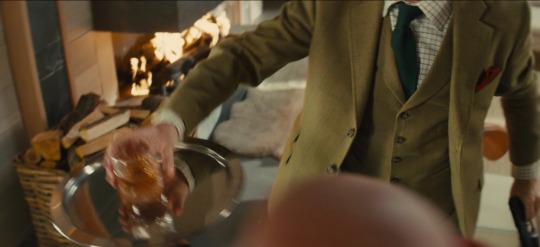
– Rescue the drink before it can fall to the floor, resulting in good guy being distracted.
– The villain never does his own legwork, because he has no stomach for violence (sight of blood causes him to vomit.)
– Umbrella gun (Brolly gun with updates – replacing meta from feb about Avengers, etc)
– Projections are treated like people in the room.
– Failed experiment in changing to more emotion in the group leads to a team member being decimated.
Eurus: This is an experiment. There will be rigour. Sherlock, pick up the gun. It’s your turn next.
And then later, she tells Sherlock he didn’t win, look what he did to Molly.
– An innocent child caught in the schemes of adults.
– Completely over the top driving scene, and lots of blue flashing lights.
– MET officer is same actor (William Ineson) as TFP fisherman.
– Placing a mysterious phone call changes events.
– Hero was involved in drugs, never had a traditional job.
– Insert inappropriate (gay) humor. “Manners maketh man…” from Vulgaria by William Horman. (SO many M’s.) Also, the first book where children’s rattles are ever mentioned.
–
A path that made the younger hero who he is, but he isn’t “locked” into
it. He can adapt and transform (even change his fate and take on
someone else’s identity.) + My Fair Lady bringing in play/film
reference, and Jeremy Brett connection.
– Surprise water! First test is near drowning. (Lesson is working together, being a unit. Soldiers.)
– Movie that breaks the fourth wall & Internet use. “Valentine: The Movie” (Valentine is a person. T6T Love, ammo not amo) & “Not
that kind of movie.” (John writing Cardiff Violins, Rosie’s birth
announcement in The Times, Janine’s interviews in HLV, BBC interview
w/Culverton, BBC covering Moriarty court case in TRF)
– Pet dog is major plot point, and makes Eggsy part of who he is, capable of being emotional and functioning as a top agent. (Redbeard)
– No concussion, but he’s unconscious? The other agents don’t know what he was exposed to, and the leader (villain) asks for footage. (Hello, EMP)
– “A gentleman is simply a patient wolf.” (Have patience, Watson. / Patience grenade)
– Again, the internet, but considering how much money they supposedly have, the graphics are very low-budget. Also, short-sighted? Description used for Mary in TEH. iPhones, for instance, don’t use separate SIM cards. (Post S4 crew explanations of the skull glowing due to blown light bulbs, etc.)
– Use the press as a cover for what really happened. (Magnussen in HLV)
“Foiled the assassination…” Eggsy jokes how probably no one thanked Harry for doing that.
– Bond style cavernous installation with top security that should be run “by someone responsible and sane”, because “bad shit happens if this falls into the wrong hands”.
– Hero that collects butterflies and insects being called a freak, by someone that doesn’t understand him yet. Also, we’re back to the situation with the dog not being what it appears. Turns out, the gun had a blank bullet (not a tranquilizer, but you get the idea.) Also, the recruit that supposedly drowned in the first test, was actually a field agent who lived, and works in the Berlin tech dept.
– You can’t hack pen and paper. (Unlike T6T Magnussen footage, and who knows what else in S2-4).
– The suit is a modern gentleman’s armor. (Adding a Belstaff is a nice tough, though.)
– Lock & Co. Hatters save the day. (Nice top hat and presumable projection glasses-Google specs?) Also, let’s have the media tycoons share the same shapes and color scheme of blue, with punches of beige and red.
– Old money, and keeping up old traditions leads to problems and weakness.
– Money and intelligence doesn’t have to equal being pretentious.
– The need for coordinates that are going the same way.
– Elaborate bunker with many minions (standard Bond film setup)
– A plane that can’t go much of anywhere or put up a defense. (It becomes just
a plot device, a vehicle with a different purpose than transport.)
– M (Merlin) played by Ritchie Holmes actor Mark Strong – he was Blackwood. Solve problems under pressure, when one member of the team might die. (TFP)
– Merlin gets nicknamed Mycroft.
This one has been awhile in coming, but… I may have missed a few things, but I think you get the point.
If you weren’t to know it’s Sherlock, and you were to see this particular scene on TV one night, you would be sitting on the edge of your seat, expecting the climax of this random film, as it appears that the protagonist has caught his lover cheating on him red-handed.
This is the face of a forsaken lover. I have nothing more to add but:
Do you ever think about how painful the Molly=John mirroring is during TFP phone call:
Sherlock, his hand forced, having to phone and ask John to do something for him, without revealing the threat to him:“I just want you to do something very easy for me and not ask why.”/ “Keep your eyes fixed on me. Please, will you do this for me?”
But then it turns out the threat is completely set-up, designed to tear the both of them apart:“Oh, do be sensible. […] Why would I be so clumsy?”
The sniper would never have fired at John in TRF. Sherlock only had to think the threat to John’s life was real. The real goal was to drive John and Sherlock apart, burn the heart out of both of them.
And Sherlock can’t stand to think that those two years were for nothing:
“I won. I saved John Watson.”
“You didn’t win, you lost. Look what you did to him, look what you did to yourself. All those complicated little emotions, I lost count.”
And some people still don’t understand why he destroys the coffin.




 Sherlock Fandom Archive