In case you’re not familiar, here are some plot elements to whet your interest:
a skeptical physiologist (Austin Gilroy) who allows himself to become a subject in a mesmerism / mind control experiment
a woman with mind control abilities
(Miss Penclosa)
who is generally unimpressive and walks with a crutch, but is surprisingly powerful
two people about whom Gilroy cares–his fiancée Agatha and his colleague, Charles Sadler–who are also both mesmerised (to offer some comfort to more tender readers of this meta, I read both Agatha and Charles as Sherlock equivalents when translated into the BBC Sherlock narrative)
obsession–specifically, Miss Penclosa’s desire to seduce Gilroy
supernatural mind control abilities that cause Gilroy to behave erratically, cause missing time, and, eventually, make him do things he would never otherwise do, some of them criminal
narrative bonus feature: the story is told from Gilroy’s perspective, in the form of his journal entries
Sound like it might, maybe, have some relevance to s4? I think it does, especially in terms of figuring out what the fuck is happening to both John and Sherlock.
Reading s4 through the code of The Parasite may help explain Sherlock’s sudden propensity for intuition / premonition, and John’s erratic behaviour. Ultimately,
including The Parasite as one of the many intertexts of s4
offers a great deal of support to readings like @jenna221b‘s theory about Mary manipulating John using TD12, which in turn adds support to the ever growing pile of evidence that Mary is a villain (thanks to @teaandqueerbaiting for that monster post). It also informs readings of Mary as femme fatale and the Woman in Green (femme fatale thread by @inevitably-johnlocked, Woman in Green addition by @deducingbbcsherlock). Although I’m not sure mofftiss should ever be let off any hooks for s4, this reading might offer John fans (myself included) a much needed opportunity for a more positive reading of John in this series.
Reading through your brilliant post @may-shepard my mind kept screaming parasite = virus in the data 😱 Series 4 indeed introduced so many threads connecting Mary to Moriarty (with a side of Magnussen); the most explicit being Culverton Smith. In addition to the serial-killer-meet-and-greet accompanied by double-ghost-Mary, the creepy scene in Smith’s murder room reminded me so much of Mary’s “You don’t tell John” warning from HLV – as in both “You don’t tell John about me” and “You don’t tell John you love him” – gave up the ghost and… off you pop. John, in the meantime, unable to fulfill his role as the blogger, remained in the narrative while it was being led astray. As Mary clearly had the last word, with the help of series of DVDs (a broadcaster), everyone’s memory (including ours) had been thoroughly corrupted and modified: Eurus, a personification of Sherlock lost, without his blogger.
Gilroy’s missing days also reminded me of Sherlock’s joke during his best man speech (chemical compounds and John’s missing Wednesday) – the jellyfish in TST haunts me still, because of the deaths by poison in The Adventure of Lion’s Mane. Now we have Blessington the Poisoner – could it be that before he was shot, John had already been poisoned little by little? But since when?
Has the real Three Garridebs been ongoing for 6 months before Sherlock’s exile? But wouldn’t that be.. before the wedding if John’s blog was to be trusted? (omg The Poison Giant post was dated May 27……where Sherlock and John never figured out who wanted them dead!) I think Mary’s intent to kill was the real sign of three (666 – the baby as the omen and the exorcist), but Sherlock made a mistake in his deduction then because he was heart broken and metaphorically bleeding out during the wedding 😭 . Did he finally realized it after TAB, and then we spent the entire series 4 watching him trying to figure out when/what/how it all went so wrong while trying to beat the clock to save John Watson?
The first bomb is actually attached to John. Sherlock and John are present at all three incidents. Mycroft is personally at 221b and metaphorically at Westminster. Is he perhaps somehow at the pool as well? If AGRA was employed by the government, and Mary was a sniper at the pool? Who did call Moriarty off? We are to believe it was Irene, but is that true? Three people, again and again… Whom will Sherlock choose? Mycroft or John? Saint or sinner? Family by blood or by choice?
Inspired by the Moffat interview where he said: “Sherlock Holmes will now wear the silly hat because Mary liked it.” (X) I have to conclude that he either does not remember the episode he wrote or he is intentionally trolling us or both. But this is not what this is about.
Mary does not like the silly hat. Nor does John make Sherlock wear the damn hat. What happens, is this:
In TAB Mind Palace John tells Sherlock to wear the damn hat. Which is exactly the sentence Sherlock refers to in TLD. Both times it is Sherlock speaking to or about himself. John has nothing to do with it.
Now to the moments Steven is alluding to which are even more telling: In TLD Mary indeed says no less than three times that Sherlock should have worn the hat. But Mary is dead. She is just a figment of John’s imagination, right? This is at least what we are made to believe. But the thing is that John has never been really interested in the hat. When they discussed it in TRF, he was completely oblivious to it, being concerned solely with the “confirmed bachelor” allusions. And Mary – while she was alive – was not interested in the hat either.
So who came to regard the hat as something belonging to him, defining him in some way? Who chose to wear it for the press after his return from the dead? Who had an imaginary John tell him to wear the hat? Who is the one creating scenarios in his mind where people from real life are acting according to his own scripts? Sherlock.
Therefore I take the whole hat business as further evidence that this is not real. And to me it is the only explanation why Sherlock addresses Mary when choosing to wear the hat at the end of TLD. Even if Sherlock had deduced that John had been talking to his dead wife, he could not possibly have known that Ghost Mary had told Sherlock via John’s mind to wear the hat. I leave you to your deductions.
Thank you for this @gosherlocked. It is still a horrible interview but your point calms me down a bit. Because it at least allows for an EMP reading of the whole of S4 – which is the best we will get from it.
So yesterday I was reading @silentauroriamthereal‘s Best of Three, again (it’s a really good story!). And I realised that the John in that story is pretty much a total dick. He’s incredibly patronising and self-congratulatory about being such a wonderful friend to Sherlock etc etc etc, all the while being actually unimaginably cruel to Sherlock.
And I left a comment to the effect that I loved the story but hated John, and she very kindly replied that she thought it was pretty in character and I had this absolute oh my god moment because she’s bloody right, isn’t she?
And somewhere between Season 4 and Best of Three and SilentAuror’s comment, I think the scales sort of fell from my eyes with regards to John and the show. It’s not that Season 4 ruined John. Season 4 was the logical continuation of where they had taken the character, arguably from the second episode. Go back and look at the way John talks about and treats Sherlock, all the way back to TBB. Try to reconcile the way John talks to and about Sherlock with the way Watson talks to and about Holmes.
Season 4 John is not out of character. Not for BBC John. It’s extreme, but it’s not actually out of character. We think it is, but I think that we have good reason for that. In my specific case, I knew and loved the canon long before BBC Sherlock came on the scene. I know Watson, and I know how he feels about Holmes. So when John acted the way he did in Season 4, I thought it was awful, and terrible, and it came as a shock to me. Before Season 4, when John acted in ways that Watson would not have, I was like “well, maybe he’s just having a bad day’, but Season 4 made me realise that Watson hasn’t been having bad days, Watson has never been here at all.
We think that John is better and wiser and kinder than he is because we spend more time with the wiser, kinder versions of John Watson that we see in the canon and in fanfiction. We’ve been blinded by those Watsons to the truth of John’s character in the show.
And that leads me to another conclusion. BBC’s John doesn’t love Sherlock. We think he does, because Watson loves Holmes, and whether you think that it’s platonic or romantic or sexual or whatever, you can’t deny that there is love there, but John? He doesn’t love Sherlock.
I think he wants Sherlock. I think he’s addicted to Sherlock. To the cases and the life they lead and the danger and all of it. And I think that, like any addict, he hates Sherlock and everything that comes with him, and hates that he needs him. And that’s why the morgue scene happens. Because John, unlike practically every other Watson in history, does not love Sherlock Holmes. Because John wishes that he had never met him and wishes that he could live without him, and knows that as long as Sherlock is alive, he will never, ever be able to leave him for good.
Which means that yes, they really did do TPLoSH all over again, with a gay Holmes desperately in love with Watson, who doesn’t love him back. Except they dialled it up to 11, because everything has to be bigger and louder and hurt more, and instead of a straight Watson who still loves his Holmes, they have given us a John Watson of ambiguous sexuality who not only does not love Sherlock, but actively despises him.
(I also have some thoughts about how Sherlock has been moving toward becoming Holmes over the course of the series, while John moves further and further away from being Watson, but I’ll save that for another time.)
why do you hurt me???
i mean, especially after s4, i felt more or less convinced that John doesn’t love Sherlock back, certainly not in the way Sherlock loves John so selflessly and unconditionally
but to see you spell it out so well and dial it up some more….. oh my heart….. oh my poor sherlock…. it makes this scene THAT much more painful to watch
I believe you are absolutely right and I think that’s why S4 has been so difficult for me. I had clearly conflated BBC John with all the permutations of John that are fan created. The fan fic and fan art Johns that love Sherlock; that nurture and protect Sherlock from that place of genuine love for Sherlock. S4 John’s character arc is divergent from those fic Johns I have read and I’m starting to see that is on me, not the BBC writers. I now have to figure out if I can go back to the fan created Johns and enjoy them for what they are, and leave BBC John behind. I’m still trying to decide.
@lawyermargo we all did, I think. But the good thing is that fanon John is much closer to canon Watson than John is! I’m not sure if that’s a comfort to you or not, but we are not, and we were not, wrong. The John Watson we see is the real John Watson. It’s the BBC version that’s out of character.
Also, there are other Johns. Try Granada! Granada John is beautiful.
Or read canon and just imagine Martin’s face on it.
@high5sandchocolate, I think this is good analysis of why we’ve been struggling with S4.
I’m so glad someone is saying this and not getting bashed for it. Before S4 I rewatched all of S1, S2, and S3 with my kids. And to be honest, I hadn’t rewatched it all for at least a year, and had been thoroughly and happily buried in fic adaptations of Sherlock and John.
I remember saying to my best fandom friend (not tagging in case this post makes her sad) at the time that seeing it all again after some time and distance made me realize that John wasn’t actually very nice to Sherlock. He was a bit of a dick.
I do believe he cares about Sherlock, and comes to see him as a friend, and I do believe John knows that he owes Sherlock his very life, and he’s absolutely addicted to him as a surrogate for the adventure. But he also blames Sherlock for getting in the way of the happy normal life he thinks he wants. He goes back to Mary because he wants to, because he’s pissed off at both of them, but he wants Mary, and he doesn’t want Sherlock. At least, he doesn’t want to want Sherlock, and he never gets past that. And he hates Sherlock when Mary dies because if there hadn’t been Sherlock, there’d be a Mary. Sherlock is John’s fly in the ointment, his virus in the system.
And I think I went as far as to say that I didn’t think johnlock was endgame, that I would love to see it, because they’re my OTP, but I didn’t think the show had given us a foundation for it. We’d spent so much time in hiatus, consuming fic and seeing subtext in three-second long clips taken out of context, and just simply dreaming and wanting, but I didn’t think it would happen.
I don’t like it. I don’t like having my johnlock-colored glasses ripped off, but John didn’t turn into a dick. He kind of always was one.
And maybe that explains why I’ve found myself drawn more and more to Victorian johnlock lately, and why I don’t really write fixits, preferring AU.
At the end of it all I still find myself shaking my head and asking, “This? This is the story they wanted to tell?”
I don’t want to bash anyone, of course, but I do disagree. Naturally, a lot of this isn’t really open to debate– I mean, these are fundamentally emotional responses that can’t be ‘fixed’ by discussing them rationally. I should know, I’ve spent a while now arguing about exactly this with my two (formerly) Sherlock fan friends. They are convinced John doesn’t love Sherlock, though at least it’s more like it’s not equal. I don’t really know what to say to the idea it’s not equal– I guess I don’t think it has to be equal? And also I think John had some serious reasons for being upset and going through serious issues, in S3 as well as S4. I mean, if you’re rejecting the importance of Mary– which is simply canon, and there in Conan Doyle’s stories as well– then I suppose both S3 and S4 will be skewed, as @wildwoodgoddess wrote. One has to accept that John did love Mary and she’s problematic but not a supervillain, even if it’s not as much as he loved (and needed) Sherlock. Of course, there’s a bigger problem if one can’t accept he felt that way about Sherlock. Yes, even in HLV and TLD. Perhaps especially in TLD, even.
First of all, I think bringing Conan Doyle’s Watson into the equation might be natural, but it muddies the waters in terms of understanding. Sherlock isn’t ‘Holmes’ either, certainly not in Series 1. Maybe he’s becoming Holmes by the end of TFP, but for the most part, comparisons are mostly interesting for the sake of contrast. Of course, John and Sherlock had a tempestuous relationship full of misunderstandings in Series 1, but the problems were quite different than they had in Series 3-4. John’s behavior in TBB was clearly motivated by significantly different factors then than it was in HLV, say. That’s not about whether he loves Sherlock– that’s just basic character analysis. He was clearly insecure about his role in Sherlock’s life, and for good reason! Sherlock didn’t quite know what to do with John yet either, and as TGG showed, they didn’t quite click as partners until the end, at the Pool. This was growing pains. Sherlock was an ass, so was John. They’re alike in many ways. It certainly makes it much more confusing than it needs to be to forget how much of an arrogant ass Series 1 Sherlock was (cute as he was). Rewatch again and you’ll see.
Anyway, by Series 2, John’s devotion is pretty clear, isn’t it? Don’t you think so?
Watch ASiB again. Watch TRF again, man. Hell, watch TGG and the Pool scene again. He loves him. He would die for him. He believes in Sherlock no matter what (although he says ‘nobody could fake being such an annoying dick all the time’). They are both ridiculous boys who can’t express their feelings. Surely Sherlock is no better? It was his brilliant idea to come back after Reichenbach by pretending to be a waiter and then making jokes (nerves, of course) even when he saw John was upset. Anyway, then there’s John’s concern about Irene treating Sherlock right (even though he was jealous), attempts to talk about Sherlock’s feelings, which was quite a step for John. He gets violent when that police superintendent dares to say a wrong word about Sherlock. He thinks– he says!– Sherlock is amazing and brilliant and could come back from the dead if he wanted. Then there’s the way he was broken in half after Sherlock’s ‘death’, and in fact Mary only ‘fixed’ him superficially, it seems. We see him at the beginning of TEH still thinking about Sherlock, visiting his grave, remembering the early days vividly, feeling so strongly about him. Yes, there was anger as well as grief, but Sherlock was an ass, and then John forgave him within days. That’s love, surely.
Basically, fanon John couldn’t match any of this in a million years. He just… likes his tea and jumpers, doesn’t he? Okay, okay, I’m kidding. I’ll admit I do strongly prefer canon John, though. Fanon John always had it too easy. His love is too easy. He generally doesn’t struggle as much… and the more he does, the more in-character he is anyway. Yes, I agree, of course canon John is a dick. Of course he is. But so is Sherlock. So is Sherlock, and they both think that’s brilliant. They giggle at crime scenes, man.
I don’t know if I have to bring up TSoT, but I suppose for the sake of completeness: it’s also canon that John thinks he loves Sherlock at least as much as he loves Mary, at least, and he says so. Essentially, this whole reading is counter to explicitly established canon characterization, although I suppose that’s beside the point. John tells Sherlock he loves him in TSoT, just a few months after the whole debacle of Sherlock coming back from the dead. The wounds from that are barely healed, but then John never stopped loving Sherlock, no matter how angry he got. As he said in the train-car, ‘of course I forgive you’. This wasn’t because he wanted some more cases and adrenaline. He thought they were about to die in moments. Sherlock’s conviction that it was just about the cases for John– ‘just the two of us against the rest of the world’– was why he miscalculated so badly in not telling John he wasn’t dead in the first place. That’s why John got so angry at that exact moment that he headbutted Sherlock! It is obviously false, and moreover, that’s a major plot point without which the characters’ motivations in Series 3 don’t make sense.
Of course, Series 3 and 4 aren’t about a ‘bad day’ or even several, even though that’s how I phrased it in my recent defense of TLD John. It’s true, that’s an understatement for sure, though what I mean was a sort of metaphor. Like, the day we meet John in ASiP, he handles his gun– clearly considering suicide. That was what I meant by a bad day. Ivyblossom really said it better in describing the moments in S4 that it’s apparent that John loves Sherlock even on his bad days. It’s true that you have to think about it; look beyond the obvious. Still, the text rewards you. TLD rewards you for that effort, should you choose to make it.
Basically, John holds it all in, and then it explodes. Sherlock knows that, too. He expected John to explode after Mary’s death; he was counting on it. As @plaidadder initially described, this was part of Sherlock’s plan. Does this excuse John’s behavior somehow? No. But there’s no reason to excuse it. John doesn’t! He feels awful about it. As he says, some things are not okay. He hates himself so much that he leaves the cane at Sherlock’s bedside (as Sherlock knew he would, since he placed the mic there), symbolizing the end of Sherlock’s first ‘miracle’, when he first saved John from his demons. That never really ‘took’, after all. John wasn’t worthy of that miracle, in his own opinion.
However, just as John always forgives Sherlock for anything, Sherlock always forgives John: no question. You could claim that’s messed up, but ‘it is what it is’, and that’s the whole point. Sometimes it’s ugly, and sometimes it’s beautiful, but it is what it is. And what it is, is mutual devotion and love. It’s just after TLD, there’s also, finally, fully mutual understanding and acceptance, as Ivy described being evident during the Molly scene. By TFP, John has clearly accepted his role in Sherlock’s life– his being family. He smiles to himself, clearly pleased but unsurprised when Sherlock says that to Mycroft. A true family isn’t something you build out of an adrenaline addiction and pure need. Of course, John still needs Sherlock, as he always had done. No surprise, because Sherlock also needs John desperately, as he said during the wedding speech: John saved him in ‘so many ways’.
They do that for each other in canon, surely at least as much as in fanon. They save each other, they need each other. Sometimes they try to deny it (as Sherlock did himself, when he left John at Bart’s), but in the end they cannot. And why? Why is it, really, that they can never deny themselves one another?
ok. i want to talk about this. i think the theory in which our boys are intermittently drugged with TD-12 is very possible. i’ve been on the fringes of this theory for a while, certain that SOMETHING other than the drugs Sherlock is taking (because heroin or cocaine do not cause hallucinations – because whilst withdrawal could cause insomnia, we see that Sherlock doses just before he goes in to meet Culverton. He is not withdrawing here. He’s literally just used, they made a point to include that). We got a really good discussion going over here, my previous meta/theory/whatever on Sherlock and his drug habits – we concluded that he’s probably taking a whole bunch of stuff, but for the sake of this particular meta, I’m going to assume he’s not wandering around London with a myriad of different, incredibly illegal substances. The context of the conversations had point to him needing a ‘top up’, which makes me think heroin (even though he says he feels ‘psychedelic’ which isn’t really… heroin, but I think he’s just referencing the fact that he’s high rather than anything else). He’s also not really “acting” high, which sort of makes sense seeing as heroin users get to a point where they need more just to function normally (and Sherlock’s been off his tits for weeks, so- yep, makes sense).
So, we know that for the morgue room meeting, Sherlock is NOT withdrawing. We know that he is pretty much… in control, or he certainly feels as if he’s in control. He has a plan, he thinks it’s going to work. He’s smug and he’s absolutely certain of his abilities.
Except it sort of… stops working in that morgue room, and Sherlock is suddenly confronted with a crisis of mental clarity via Faith. I think this sudden shift from confidence in his abilities to the realisation that he got it wrong sort of sent him spiralling. This is where the TD-12 shit comes in, because I cannot think of any other way to explain this particular scene away…
Sherlock is hearing auditory hallucinations. His mind begins making connections that are not there. He sees Culverton pick up a scalpel when he is the one to pick the scalpel up, we see him begin to physically lose his grip on reality and he, quite understandably, freaks the fuck out. He feels as if he’s being mocked, moments after Culverton has mentally mocked and derided John and his abilities as a doctor: Culverton has made both of these men question their sanity and their usefulness in the space of minutes. But here’s the important part: I think Sherlock hallucinated more than just the laughing. I think Sherlock hallucinated the severe kicking he got from John, too. Let’s break it down.
Sherlock isn’t just experiencing auditory hallucinations here. He’s seeing Culverton laugh, he’s hearing it and he’s seeing it and it makes him angry, likely because he feels as if his intelligence is being mocked. But check out this screenshot: this is a pretty freaky thing to see, so it’s no wonder Sherlock begins feeling threatened.
This is where it starts to get a bit Nuts. Sherlock brandishes the scalpel and demands Culverton stop laughing – and yet even when Culverton says he’s not laughing, the laughing continues in the background. John is forced to step in, to control the situation and the blatant manic episode Sherlock is going through and he’s forced to punch Sherlock to snap him out of it.
What does John say to Lestrade, in the scenes running intermittently between this morgue scene?
“I really hit him” Odd thing to say, if you’d kicked someone too. Surely you’d say “I really hurt him’ rather than put emphasis on ‘hit’ if he’d actually kicked Sherlock into submission, because that wasn’t just a singular ‘hit’. That was… brutal, honestly.
Here’s the interesting part, the camera zooms in on John’s hands, just before the beating above is shown.
Keep in mind that this beating is so bad that Sherlock spits up blood. This is like, internal organs being kicked to shit bad.
But here’s the thing, in the following scenes, that blood? Completely disappears.
Where’s the blood? Are you telling me that in a show where they physically painted a pub door sign for literally two seconds of footage are going to forget to place the blood down? nope, sorry, not convinced.
So, here’s what I think ACTUALLY happened in handy dandy bulletpoints:
John gets in between Sherlock and Culverton when he sees the scalpel
John crowds Sherlock up against the morgue doors
John punches Sherlock when he realises he’s not snapping out of it
Sherlock falls and hits his head against the morgue doors, which is why he needs stitching on his eyebrow.I literally have no idea where this eyebrow cut came from otherwise.
Sherlock probably gets a concussion here, let’s be real, so anything that happens in between falling to the floor and John apparently being dragged away by goons that show up out of nowhere should be questionable at best, possibly even including the I killed your wife dialogue.
The only other POSSIBLE explanation I can have for John beating Sherlock in this way is if he, too, is drugged, and starts having a massive PTSD freak out but that doesn’t account for the missing blood.
Either way, I don’t think this scene happened the way it’s been set up, because there’s too many inconsistencies. John’s characterisation here is really weird at best: I can’t see him beating the shit out of Sherlock like this without some sort of… trigger? who knows
@worriesconstantly: This is excellent. And you know what it reminds me of? Remember this strange little scene in HLV before they go up to CAM’s office?
SHERLOCK: If I was to use this card on that lift now, what happens? (He gestures towards the lift where an imaginary version of himself is touching his card to the security reader. Alarms immediately begin to sound – at least in Sherlock’s head – and two imaginary security men run towards imaginary-Sherlock standing at the lift.) JOHN (obviously not seeing or hearing anything): Er, the alarms would go off and you’d be dragged away by security. (Over at the lift, imaginary-Sherlock is indeed being seized by the arms by the two men.) REAL-SHERLOCK: Exactly. (He looks towards the lift and watches as imaginary-Sherlock is marched away.) JOHN: Get taken to a small room somewhere and your head kicked in. (Imaginary-Sherlock looks over his shoulder and throws an indignant look towards his real self and his friend. Real-Sherlock looks round at John.) SHERLOCK: Do we really need so much colour? JOHN: It passes the time.
Someone’s imagination running wild, just that time it was John’s. Like with so many things, S4 is supplying us with distorted, overdramatic versions of earlier elements of the show. And this might be another one. Sherlock is drugged and has been under extreme stress for weeks or months of which angry, distant John is the source. So no wonder he might imagine something like this.
HOLMES: A seven percent solution.
Would you care to try it?
WATSON (tightly): No, but I would quite like to find every ounce of the
stuff in your possession and pour it out of the window.
HOLMES (smirking): I should be inclined to stop you.
WATSON: Then you would be reminded … quite forcibly … which of us is
a soldier and which of us a drug addict.
HOLMES: You’re not a soldier. You are a doctor.
WATSON (stepping closer to him): No, an Army doctor, which means
I could break every bone in your body, while naming them.
I think this could be very easily another forshadowing of the beating scene in TLD. And as so often in this show the intensity of similar events increases with every repetition.
talking about someone kicking Sherlock’s head in
talking about John breaking every bone in Sherlock’s body
Faith tries to write down what happened before she forgets, but her note is confiscated by the perpetrator.
It also happens during Sherlock’s sequence of deducing Culverton’s “anyone” was the one word of the person he wanted to kill. The transition at the top also has a weirdly ominous tone with Sherlock passing by, and while the episode and series has other transition shots like it, it reminded me specifically of the end of the episode with the shark:
As I explained here, while Magnussen is also compared to a shark in His Last Vow in relation to the Samarra metaphor, the grim figure of death is actually Mary. In an episode filled with shark imagery that very much jumps the shark, beginning the bad reviews of the season, and doesn’t make sense because it’s not real.
Mary is the shark, Mary is death, Mary is Samarra, Mary’s supposed post-humous Retro-Netflix DVD Subscription message is the final shot we see in The Final Problem before the last shot of John and Sherlock being frozen in time. Mary is still alive, somehow altering what we’ve seen with the TD-12 drug.
Immediately afterwards as Vivian Norbury is dragged out like a Scooby-Doo villain with a projector behind her (“that’s not how it happened at all”) we see Mary’s ashes supposedly enveloped by flames.
This satanic imagery links her to Moriarty once again (the I.O.U. apple as Satan offering Eden the apple in The Reichenbach Fall, Moriarty in the valley of death in The Hounds of Baskerville), as did the script of His Last Vow, referring to her as “satanic.”
The flames are blue, linking Mary again to the blue visions of water Sherlock keeps having, Mary is the shark again, Sherlock keeps thinking it must be Moriarty. The connection to Eurus and Victor in The Final Problem doesn’t make sense because it’s not real, Sherlock has no reason to connect that to this moment, aside from the incredibly loose “Eurus killed Trevor, Eurus recorded reaction gifs from Moriarty five years ago, I have no way of knowing that tho as I stare at the missing figure of Thatcher which has the AGRA USB inside” which is already discarding the Mary connection.
Mary and Moriarty are the same person. “It’s the gap, it’s wrong.” Blue is fake.
John is seen walking through a graveyard as the shot is out of focus, and he looks like he’s dissociating (that 2017 #mood):
Someone is calling him but he doesn’t answer. He returns to the same dissociative march.
Zooming in and stretching out, the number is private.
This is reminiscent of Molly in The Final Problem, letting us know again that Molly is a mirror for John. Molly/John needs Sherlock to say it first before they can say it back, except with her the phone did say “Sherlock”, and in this instance John literally CAN’T answer because he is being prevented from answering the phone and communicating with Sherlock. Phones are heart metaphors, John can’t answer his heart, they can’t love each other because the the truth is being obscured.
Molly gives Sherlock the letter from John. In the context of how much this miscommunication/last minute confession has been set-up over the course of the show in terms of John and Sherlock confessing their love for each other, which was planned to be and will be the climax, this is the planted seed to uncovering what’s going on as we’ve all been saying, it was left unresolved on purpose.
Also remember that Mary literally did already drug Sherlock in this version of events by bringing and… drugging a fake note, bringing chloroform to a meeting containing information about her past that she had no way of knowing about, designed as part of the alibi to make Mary on the run look as good and redemptive as possible. lmao I don’t think it was a baby thing she was hiding in her fanny pack
Mary isn’t dead, she faked her death, drugged John, and is back for revenge. The ultimate revenge of keeping them apart. Mary and Moriarty are Emelia Ricoletti:
Some of us assumed that John in the well would be the Garridebs moment, but it was faked. There was so much discussion about the hands in the opening, The Lying Detective’s first shot and it’s last not matching I didn’t realize.
Of course, as The Abominable Bride told us, John will be the one to save the day after John and Sherlock admit they love each other. If Mary and Moriarty are the same person but Moriarty is really dead (which seems up in the air, but Mary is definitely alive), John shooting Mary could be the equivalent.
The real Garridebs moment is still out there, frozen in time with the teacup as well as John and Sherlock in the last shot of The Final Problem. Sumatra is still out there, the bomb waiting to explode. It can still be prevented.
Leak the special, you monsters. John’s been bleeding out for almost two months.
Aaaaaa those transitions! 😱 omg I love this thank you so much for the tag! 💖
You may know how much I love looking for parallels and mirrors in “Sherlock”. I am not sure if this has been discussed before but in TAB and S4 we get two women
Wow, I really like this connection! It makes me wonder: if Eurus is a repeat of Emelia, was there an “original” woman on which they were both based?
Dark hair, white dress… there seem to be two candidates for this one:
Hmm… (Does “fake relationship” sound familiar? *cough* bus lady *cough*)
While I love Janine, I can’t remember her ever using a gun, so I’m just going to skip over her for the moment because the other option just fits so darn well:
White dress, dark hair… but a gun? Irene doesn’t– oh, wait:
*I mean, Emelia was involved with a man who had connections to America, too…*
So here’s what we’ve got:
faked death/was assumed dead
names start with and contain lots of vowels (and “i” and “e” are very similar sounds)
presence is announced by a specific noise – not a song in Irene’s case, but a ringtone. It has a similar effect; it’s simple, personalized, and kind of out of place for its surroundings
I’m sure there have been plenty of metas comparing Irene and Emelia, since their appearances really are strikingly similar, so I’ll focus on Irene and Eurus.
First of all, both mention “Christmas presents;” Irene sends Sherlock her gift-wrapped phone for Christmas when she fakes her death, while Eurus talks about getting her violin and Moriarty as gifts.
1. Irene had the Moriarty connection too… and even though it’s kind of assumed that Moriarty is the ultimate boss, maybe Eurus’s mind-control/collaboration with Moriarty was meant to show that Irene actually had more power than she got credit for. I mean, she was the one to go to Moriarty in the first place, and even though she texted him the info about Bond Air, that was mutually beneficial. She didn’t just do his bidding because he’s the villain; it was a business transaction. She had power. The only reason why she didn’t win was because she wanted to have fun with Sherlock, and he figured that out in the end. With Irene, he guessed the passcode because of her interest in him; with Eurus, he solved her riddle and realized that she was calling for help. (Come to think of it – did Irene interact with anyone other than Sherlock, Mycroft and John? Or is this another similarity to Eurus?)
2. The violin connection is interesting, because Sherlock played the violin a lot in ASIB. In fact, one of his two compositions that we hear is “Irene’s theme” (which is probably about his feelings for John), and of course there’s the famous moment from the opening credits montage where he plucks a violin string so sensuously in front of the fire while spacing out thinking about John, before Irene tries to get him to talk about dinner. And then of course he plays “Irene’s theme” for Eurus, when she tells him to play “you.” (My mind just made a “you”/Emelia connection. Gah.)
We also see Sherlock play the violin at the very beginning of TAB, before Lestrade comes in with the Emelia case. Wait, hang on… what day is it….
IT’S CHRISTMAS. Emelia carries out her plan around Christmas time. (I don’t know if it’s the exact date…?) There was literally no other reason for this, since we get zero Christmas festivities, and the holiday isn’t so much as mentioned except for the awkward moment when they all get their “Merry Christmas”es out of the way and get on to interrogating Lestrade about the case.
So… what is the point of this? Why all the similarities?
Well, this is how I see it:
Irene was enormously important to Sherlock. In fact, she was pretty much the only woman of note: she rivaled him in intellect, challenged his assumptions, offered enough of a mystery to feed his curiosity. (Sorry, but Molly and Mrs. Hudson are both side characters, even acknowledged as such: “I don’t count”/“I’m your landlady, not a plot device,” and Janine and Mary are more relevant to Sherlock’s relationship with John than to him personally.) Irene was The Woman, the model upon which Emelia and Eurus are based. (This is even echoed in Emelia’s description as the Bride, and I suppose in Eurus’s “the east wind,” although that wasn’t used so much.)
So why the Emelia/Eurus dichotomy? Well, you can see Irene in two different ways:
as Emelia, Irene is involved in a noble cause. She seems a lot
more respected than Eurus; I certainly tear up every time I watch the
scene in the crypt where Sherlock explains that “every great cause has
martyrs; every war has suicide missions” and describes the army of women
“ready to rise up in the best of causes, to put right an injustice as
old as humanity itself.” It’s clear that Sherlock respects Emelia and
her cause. I like the common theory that Sherlock views himself as a
similar martyr; he faked his death for John, and then was forced to
watch him wed another. The bride’s connection to Mary is clear, but she
seems to be meant more as a mirror for Sherlock. Her connection to Irene
is likely due to the fact that Irene was instrumental in helping
Sherlock to puzzle out his heart; she came between him and John,
revealing their feelings for each other. And remember, Irene is also a
mirror for Sherlock. She faked her death as part of the long game (and
hopefully is now happily reunited with Kate); she was strategic, a
“formidable opponent.”
as Eurus, Irene is clever, manipulative, involved with Moriarty. She understands people and likes to play games with them; we even get a horrific allusion to sexual desires (and much as I hate to think about it, maybe Irene’s lesbianism is what inspired Eurus’s comment about not noticing the gender of the nurse she ravaged). She can also be seen as childish. She doesn’t seem to care that people will get hurt (both use tranquilizers/drugs, and refer to people more as playthings with uses, rather than as fellow human beings). At the end of the day, her game is unfulfilling, and she is saved by Sherlock’s mercy.
Irene’s taunts about Sherlock seem to have influenced Eurus’s mocking tone. She asks about sex in a very direct manner, which undoubtedly stuck with him. There’s also some taunts along the lines of “don’t be so boring.” It seems that this version of Irene is much less mature than Irene herself; I would say that either this demonstrates Sherlock’s feelings about sentiment as a silly game, or it serves as an immature mirror for how Sherlock sees himself. (Remember, Irene was a mirror for Sherlock, too.)
the airplane connection is something to think about…
….aaaand this is getting really long so I think I’ll bring it to a close, but I would love to keep talking about this later so please add your thoughts onto this!
——–
TL; DR: Sherlock is haunted by the memory of Irene, and so she keeps reappearing in his Mind Palace. Emelia represents the noble, intelligent qualities that Sherlock respects about her, and that he likely sees in himself; Eurus represents the more monstrous, childish characteristics that he doesn’t like to confront.
Hey same ridiculous insomniac anon do you know what gets to me too??? John cheating on Mary even if it’s texting… people argue that it’s in character he’s a womanizer after all but isn’t he the guy who’s loyal very quickly? What do you think?
Hi Nonny!
Yeah, I never understood why they went the route of making all of S4 essentially NOT about John and Sherlock. I liked the visuals of T6T and TLD, but Mary REALLY fucking killed it for me, especially the magical redemption arc they chose to give to her. The whole season felt really ooc for me, and Mary being more of Sherlock’s partner than John was REALLY rubbed me and many others the wrong way. The way the narrative was going, it SHOULD have been her being on the run FROM them, not working WITH them.
Because of this, I really, really feel like there is a false narrative at play here, that the entirety of S4 is being told like a blog entry(hence why they stopped the blog AND used the title of one of the entries to clue us into this fact) because of all the OOC-ness, inconsistencies, fourth wall breaking, “scene jumping” and the “fakeness” of Mary’s death and TFP. The season contains a sense of adventure, is romanticized (though in the wrong direction), and fantastical elements, just like the blog. I found it SO bizarre that Sherlock CONSTANTLY kept saying “I’m Sherlock Holmes!”… just like John’s blog would have done. And TFP for me is John’s TAB, so there’s already an alternative narrative. Anyway, this went way off topic, but you get me. John’s blog is playing out on screen. Why, I don’t know; perhaps to show the general audience that not having John and Sherlock in the picture together doesn’t work, since most of the entries are told as if John is standing on the sidelines watching events unfold – ergo making the season seem very not-our-show. Plus, calling the first episode “The Six Thatchers” after a blog entry on John’s blog and ENDING the season with Mary narrating is so telling to me.
Second part of your ask: I AGREE. It’s really weird to me, simply because we SAW John was essentially done with dating by the end of ASiB because he was happy with whatever he could get with Sherlock. And it took him TWO YEARS to mourn Sherlock before he decided to move on, and for whatever reason, Mary was able to establish that trust with John within six months (I presume she emulated what she thought John wanted, but she’s a professional manipulator). He only stayed with Mary because he didn’t think Sherlock wanted what John wanted, and perhaps also some manipulation on Mary’s part, convincing John that Sherlock would never love him like she loved him.
So then when John is “cheating” I find it really OOC, if only because I just can’t see John ever wanting to get involved with anyone every again after the heartbreak of both Sherlock and Mary. Though, I still hold the belief that it’s really Sherlock John is texting in T6T, and we are told otherwise because of the false narratives (given that I think that the episodes are being told like a blog entry, it’s only natural to assume lies about the things truly happening are present). And maybe it was “just texting”, fine, but it just doesn’t really fit John’s character to me unless that person is Sherlock or unless John is doing another plan behind everyone’s backs with Mycroft (ie. the texting is coded and E is an associate of Mycroft). He has serious trust issues, even an emotional affair with some rando on the bus just doesn’t jive with his character arc they’ve built up over three seasons.
I don’t know. People say it’s in his character, but I just have a really hard time seeing it, especially since he knows the kind of person Mary is (killing Sherlock for trying to tip off John), like… I can’t imagine he would do that again. Mary’s complete shift from the character she was in S3 is what’s tipping me off the most about a false narrative, and as such we can assume the other characters may not be who they seem to be as well, at least in my opinion.
sora-the-soulless said: Mary didn’t try to kill Sherlock. As he points out, she specifically shot him in a way that he would survive “You saved my life” does anyone pay attention to these things or…? There’s no false narrative, the show’s had sloppy writing all throughout series 3 to now I don’t see why it’s suddenly a hidden conspiracy like it hasn’t always been here
Yeah, uhm, @sora-the-soulless I’m gonna have to say that we are both watching two completely different shows, then, and you are reaaaaaaalllly not going to win this argument. I have spent nearly two years studying her character arc and writing a tonne of meta about her character and her purpose in the narrative both surface level AND subtextual. When I write meta, I write without bias from proof presented to me in the narrative. Which than leaves me to say this: I’m sorry but what part of “she went back to Leinster Gardens WITH A LOADED GUN MOUNTED WITH A SILENCER AND POINTED IT AT A MAN IN A WHEELCHAIR” doesn’t scream “she tried to kill him”????? WHAT PART OF “she murdered me”I N HIS OWN HEAD DOESN’T SCREAM “killed him”?? Sherlock said this TO SAVE HIS OWN ASS AND TO PROTECT JOHN. SHE HAD A LOADED WEAPON ON HER AT A TIME WHEN SHERLOCK WAS LITERALLY DYING WHILE COMING UP WITH A STORY. Why do Mary-stans refuse to see what is in front of their faces??? WHAT SHOW ARE YOU WATCHING? I’m not trying to be pedantic, but you are forcing me to drag out my receipts about her.
I have a tonne more from others, but I know you’re not going to read these. Anyway.
ALSO, HERE’S SOME RECENT PROOF: She uses Sherlock’s love for John against him; SHE TELLS SHERLOCK TO PUT HIMSELF IN DANGER, THEN JOHN WILL COME SAVE HIM. Sherlock is SO desperate to have John back, that he jumps at the chance and does it. SHE DOES THIS. POSTHUMOUSLY. AND THEN IT’S LATER REVEALED THAT JOHN WOULDN’T HAVE DONE IT. THE ONLY REASON HE SAVED SHERLOCK IS BECAUSE HE FOUND THESE DVD’S THAT HE DIDN’T KNOW ABOUT.
JOHN DIDN’T KNOW ABOUT THE DVDS. ERGO, WE CAN THEN PRESUME THAT MARY KNEW THAT JOHN WOULDN’T GO SAVE SHERLOCK – ERGO SHE BASICALLY TOLD SHERLOCK TO KILL HIMSELF. SHE HATES HIM SO MUCH THAT SHE WANTS HIM DEAD EVEN WHEN SHE IS “DEAD”.
THESE ARE THE FACTS. THIS IS SURFACE-LEVEL SHIT.
AND JUST TO BE CLEAR: I DO NOT HATE MARY. She was written as a villain. STATING SHE IS A VILLAIN IS NOT MARY HATE, IT IS MARY FACT. FOR CHRIST’S SAKE, THEY DIRECTLY LINK HER TO MORIARTY WITH DVD’S THAT SAY “MISS ME”. I don’t know how much clearer this can be.
This is one reason why people think there’s a conspiracy going on, because her character did a complete 180˚ in S4. SHE SHOULD NOT HAVE HAD A REDEMPTION ARC.
Clearly I am never going to convince everyone of all the proof and facts about Mary’s villainy, no matter how loud I shout them. But you have come to the WRONG BLOG to try to stan for Mary, because I’ve receipts for literally every moment in the series for her. Please, I welcome your debate points, but I can guarantee to you that this is one argument we will disagree on completely. I am one of the biggest proponents for villain!Mary because THE NARRATIVE HAS SURFACE LEVEL FACTS TO PROVE IT.
THAT ALL SAID, WHY DO YOU FEEL THE NEED TO STATE THIS ON MY POST THAT ONLY BRIEFLY MENTIONS MARY? I respect your opinions, and I know damned well you aren’t going to read A SINGLE IOTA OF A SENTENCE on any of the posts I linked to in this response, but let’s be fucking real here, if Mary was a guy, and John and Sherlock were women, we would NOT be having this ridiculous argument and you coming off as a murder-apologist. But anyway. Please, show me your proof with evidence about how Mary is a good person and genuinely cares about anyone but herself.
“if Mary was a guy, and John and Sherlock were women, we would NOT be
having this ridiculous argument and you coming off as a
murder-apologist.”
All of this. I am constantly in awe of Inevitably and their extensive meta. I want to repeat this because I just feel this so hard and it actually -angers- me when people buy into Sherlock’s lie and try to paint Mary as being something other then what she was and defend murder?
Sherlock Holmes’ heart stopped.
The doctors pronounced him dead.
He died. Mary killed him.
Sherlock restarted his own heart.
He could have just given up. His fighting back for life and restarting his own heart was what saved him and it was not Mary’s doing. It was his. She did not save him. She stopped his heart. He DIED. He was about tostay dead until he thought of John. HE saved himself from the edge of DEATH.
She intended to kill him. Everyone saw. On the screen. Just because Sherlock says something when making up a story does not make it true. Sherlock lies. We saw sherlock die. THAT is true. Mary killed him.
So no. She did not ‘save his life’. That was a spoken LIE.
Thanks for your additions, Lovely. I forgot to mention the “Sherlock actually died” bit 😀
I’ve been revisiting Skyfall lately, and I know we talk a lot about the visual references to this film in Sherlock, but something struck me on a post-S4 rewatch – this woman:
Eve is a field agent in training, full of potential. We meet her in the opening action sequence; she’s ordered to kill the man James Bond is fighting on a moving train, at long range. She misses her target. She hits Bond instead.
For shooting our occasionally problematic hero, Eve is suspended from fieldwork. This is an incredible consequence: she described the situation clearly to her superior, and M ordered her to “Take the bloody shot”. It’s a mystery that Eve should be suspended given that she both followed the order and displayed great skill in getting as close as she did to hitting her target.
She and Bond meet after he recovers, and they exchange banter about her shooting skills and whether she is suited to be an agent. “Fieldwork’s not for everyone,” Bond warns her.
In The Empty Hearse, we’re given this Skyfall-esque shot of Sherlock once he returns from exile.
At first, we interpreted this as an indication that Sherlock may have been working for MI6 during his time away, and it solidified our identification of Mycroft with Bond’s M. But in Skyfall, Bond’s contemplative look out over London near the end of the film is almost immediately interrupted by Eve, coming to give him some of M’s effects. They discuss her career.
Bond: I thought you were going back out on active service. Eve: I declined. You said it yourself – fieldwork’s not for everyone. Bond: If it helps, I feel a lot safer.
They return inside together, and it’s revealed to Bond and to the audience that Eve’s last name is Moneypenny. Now that she’s given up her career as a field agent, she’s found her place as M’s receptionist.
From the point of view of giving Moneypenny (who is an essential member of the Bond entourage) a backstory, this is great. It makes the character a bit BAMF-y, and puts her and Bond on slightly more equal footing for their verbal sparring. They’re giving her some of the ambiguity Anthea’s character has in Sherlock. In A Study in Pink, she escorts John to his meeting with Mycroft, but she’s dismissive of him. In The Empty Hearse, she fetches Sherlock’s coat, but she has clearly been briefed on the “underground network” and is expected to join in the discussion.
“One of our men died getting this information.”
But from the point of view of Eve the agent, this career trajectory is bullshit, and it was called out as bullshit in a lot of Skyfall reviews.
So… why is it that the largest part of the Sherlock audience is so willing to accept Mary Morstan going from this:
To this:
“Oh, you’d be amazed at what a receptionist picks up. They know everything.”
Even when Mary was a “part-time nurse” in The Empty Hearse, we saw her perform no clinical duties – all of the work she did on the screen was administrative, which is odd.
The Sherlock creators use visual references to other works to tell the audience something they won’t say explicitly. I’m beginning think that one of the reasons we’re given links to Skyfall throughout S3–S4, which are the seasons that feature Mary, is to draw attention to the utter wrongness of having Mary slide into a receptionist role from being a highly competent field agent. We knew it was wrong for Eve Moneypenny; we should recognize that it’s wrong for A.G.R.A., too. There has to be more to this character than what we’ve seen on the screen.
I was thinking yesterday and I realised I never questioned how well Moriarty was able to sell his fake actor persona. Sherlock thought it was because of the key that’s able to break into every computer, but we know that that key doesn’t exist, so how was moriarty able to do it?
I definitely hated the reporter chick, but are you telling me she didn’t at least check out these shows and see if he was actually in them? And it took the police over two years to prove Moriarty was actually real. If all of these were fake I’m sure it would only have took them a couple of days. Or what Moriarty was actually an actor on the side in case this situation ever came up?
No, I think Richard Brooke got the same deal as the cabbie. Maybe he was dying as well and in exchange for money he took up the persona of Moriarty.
So, who’s behind Moriarty? Mary, of course. She’s been orchestrating all of this from the beginning. Remember in the blind banker just before Shan was killed, she got a message from M and we assumed it meant Moriarty? Well, what if it was actually Mary?
It was Mary all along who wanted to burn Sherlock’s heart out. She made him into a fake and got him to take his own life. I do think that for a while there she actually believed that he was dead, but if Anderson could figure out he wasn’t dead then so could she. She called Mycroft and got him to tell the police and media that Moriarty was real and Sherlock is innocent, so he could come back.
So, I think she realised that killing him wasn’t the best idea anyway and decided to take something way more important from him, John. And boy did she try to break them up. Marrying him, then getting pregnant all that just to chain John to herself.
Shooting Sherlock in HLV was a mistake, because she didn’t plan on him interrupting her. What Magnussen knew could have blown her whole operation apart and she had to stop him, but also couldn’t let Sherlock stop her.
And then in s4 we really saw her evil side. Saving Sherlock from a bullet and making John lash out at him trying to drive a wedge between them. Sending Sherlock to hell was just a little bonus.
This is it though. She ruined him and the possibility of John and Sherlock ever getting together. I mean look at her evil face. This was her plan all along.
But yet again she underestimated the love John and Sherlock have for each other and that they can always find their way back to one another.
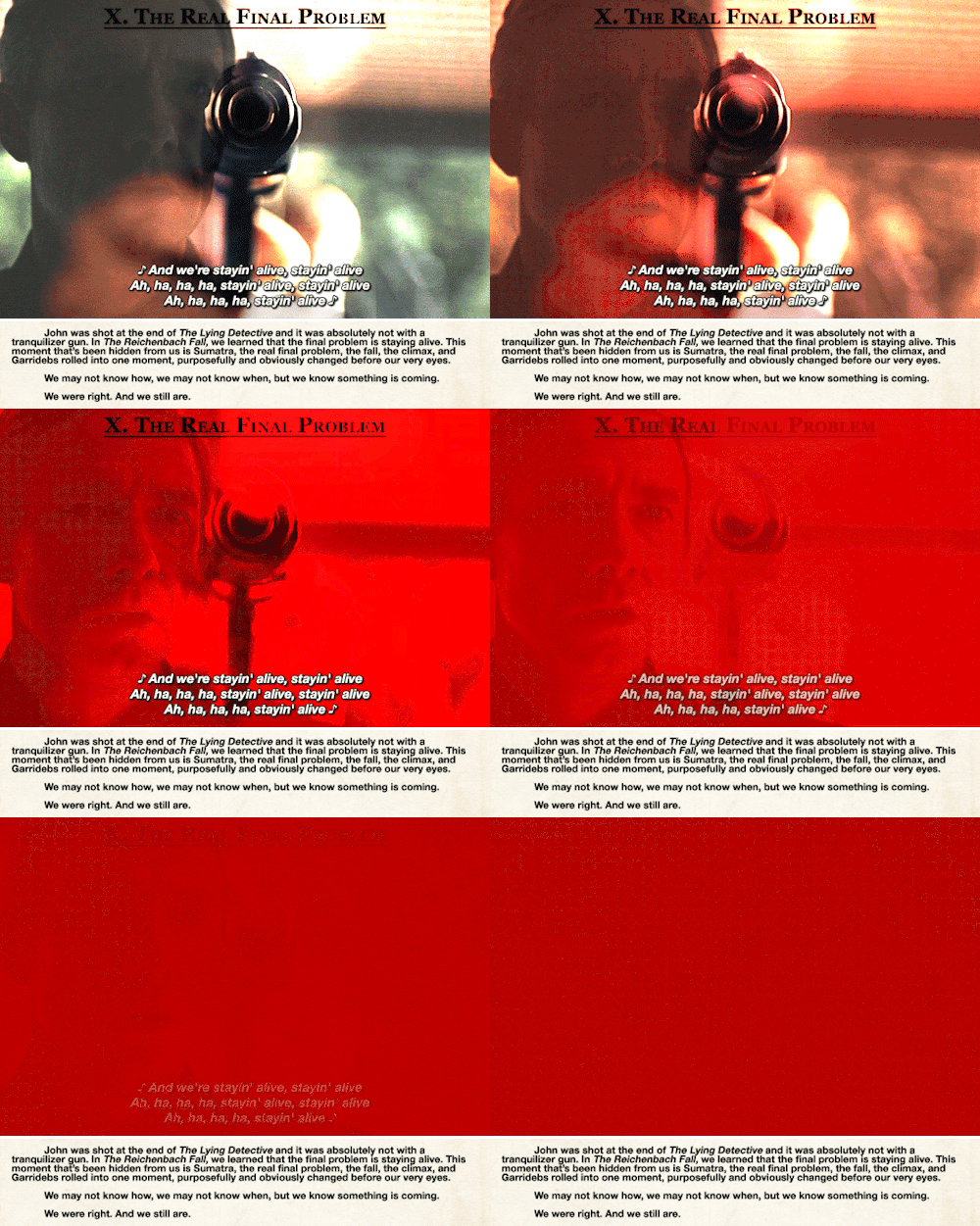
So, I think she was done waiting and just ended up shooting John. There’s no Eurus, it’s always been her and she put a bullet through John’s eye and Sherlock is the only one who can save him.
So yeah this is my theory, on the one hand i hate it cause it would mean moriarty is not real but i love him so much, but on the other hand it would reveal mary to be even more of despicable human being than we could have ever anticipated.
Sorry if this has been talked about before, please do link me to other metas on this if you have any.
Tags under the cut (if you want me to untag you please let me know, i just don’t have too many followers but am excited about this)




 Sherlock Fandom Archive