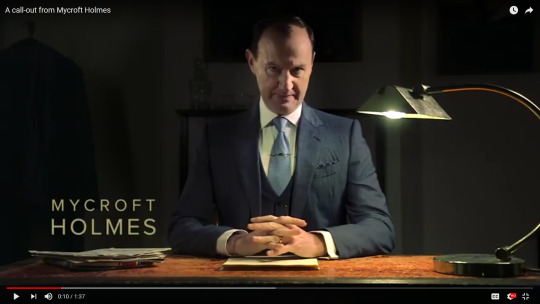
Ever since the Kingsman movies have come out, whenever Mycroft gets REALLY annoyed with someone he’ll flex his hand on his umbrella and just quietly say “Manners maketh man,” and instantly gain silence and cooperation.
Mycroft has put out the call. The Network needs volunteers. Can you fill the shoes of the legendary Sherlock Holmes?
Sherlock: #TheGameIsNow is the Official Sherlock #EscapeRoom Game from Steven Moffat, Mark Gatiss & Time Run. Coming to London 2018! http://www.sherlockgame.com/
Indeed. When I first saw this scene, yes, it was kind of funny, but all in all I felt really sorry for him. They break into his house, change his movies, terrorise him in his own home… All of this because they want Mycroft to say it, and instead of, say, snooping in his documents (which is something much more easier to make, and doesn’t instantly give away anything), they decide to go to his own house, interrupt the only leisure moment we see him have in the show, and scare him until he admits it, even reaching to the point of disarming him, leaving him with no bullets, for him to lose almost all of his dignity, and then proceed to laugh about it. And then, instead of listening to his “it’s dangerous, so don’t do anything stupid” advice, they decide to bully him until he admits to ask help from them. And I’ll repeat it. Ask. It’s not like “hey, you’re my big bro, and this is a problem that affects us all, so let’s figure it out”. It’s more of a “hey, you secret keeper, ask us help, and then we’ll help you out.”
So yes, it might seem like a funny scene. But it really isn’t, for me at least.
But what I find interesting is that Sherlock’s charade is a smaller version of Eurus’ head games later in the episode. They both indulge in the idea of terrifying people – family members even – until they reveal the truth to you. (Which makes me think there were some understandable reasons for Mycroft keeping Eurus and Sherlock separated.)
I chose to believe that Sherlock recognised those similarities as he got to experience it from the other side, and it made him regret how he treated Mycroft. (It makes sense given the uncharacteristic concern shown by asking Greg to look after Mycroft and defending Mycroft to their parents.)
“But what I find interesting is that Sherlock’s charade is a smaller version of Eurus’ head games later in the episode.”
I.. I.. I never thought of this way and now I can’t think of it in any other way holy fuck…
This gets really interesting if you accept the mind-bungalow concept that TFP is playing out in John’s subconscious as he lays dying on his therapist’s oddly-striking rug. Because this is the Sherlock John thought he saw after the old woman’s murder in TGG: someone driven by the Game until he’s just plain cruel. And there’s John right behind him, all smug (and uncaring) smiles.
This is John’s nightmare, both of Sherlock and himself.
The thing I really like about TFP, especially working within an EMP theory of some sort, is that Sherlock becomes so human. He is shaken. He struggles, is sometimes wrong. He refuses to make a calculating decision by shooting Mycroft or John. And he’s so empathetic toward Eurus (and if anyone has a right to simply hate her, maybe even more than Mycroft, I think it’s Sherlock.
Here’s the beautiful bit: if this is all in John’s mind, this isn’t about the audience learning Sherlock isn’t some kind of ubermensch who transcends the mere mortals around him.We already know that. It’s about John learning that. It’s in many ways the Garridebs revelation, slightly inverted. And a lot of the time I’m too scared and jaded to really believe in overarching purpose and details that mean that, but when I’m brave enough to go there, this is the bit I love.
Therapist: What about his brother? John: Mycroft? He’s fine. I mean, obviously normal and fine are both relative terms when it comes to Sherlock and Mycroft. Therapist: [Chuckles.] Obviously. But, I didn’t mean Mycroft. I meant the other one. John: Which other one? Therapist: You know, the secret one. John: Oh, that was just something… I said. I’m sure there’s… [He pauses.] How did you know about that? I didn’t tell you that. Therapist: You must have done. John: I really didn’t.
Images 1–5 above: From The Lying Detective, starting at approximately 1:02:58 Image 6: Zoom in on reaction of female agent in background when John first says the word “brother”
First of all, I need to make it clear that this catch—and it’s a great one—1000% belongs to @discordantwords. Not me. The only reason I’m building out a new post instead of reblogging the original is because when I saw the stills I went “Eh, maybe?” but when I saw the video I went “Woah, YES.” So this felt like something that needed a gifset.
Several times in this show, Sherlock Holmes is referred to as a ‘dragon slayer’. Moriarty taunts him about it in TRF, through a mock fairy tale in a taxi. Mary repeats it in TST, when he offers to help her (again). Even Sherlock’s own brother gives him this title in HLV, although a bit condescending as usual:
Mycroft thinks this is how Sherlock views himself:
I’m not so sure he’s right, though, since I believe Sherlock’s self esteem isn’t really as high as it may seem. Both Mycroft and the villain Magnusen have also mentioned Sherlock’s ‘damsels in distress’ – people he has to save at any cost. John is supposed to be one of them, and that may be very true.
But who is it – to be honest – that usually does the actual ‘slaying’ in our story? Who is the brave knight that goes into battle to take down the enemy?
In ASiP, when Sherlock risks his life just to prove he’s clever, it’s John who ends up shooting the serial killer:
In TBB John is supposed to be on a date with Sarah, but Sherlock lures him into adventures again. When the criminals kidnap John and Sarah, Sherlock comes to their rescue. But he fails to actually save them, and it’s ultimately John who manages – lying on the ground with his own hands tied – to kick the crossbow pointing at Sarah, so that the arrow hits the murderer instead:
In TGG John is kidnapped – again. Sherlock has a gun but can do nothing with it since Moriarty has John covered in explosives. But somehow John always manages to turn the tables around. Who’s the ‘knight’ here?
In ASiB the villain who works for Moriarty is Irene. She drugs Sherlock and plays a dangerous game on him and his brother, and John is lured away for the umpteenth time this show. This ends, however, with John confronting Irene (verbally) in the Battersea Power Station, ordering her to stop playing and tell Sherlock she’s alive.
In THoB Sherlock did – as usual – solve the puzzle, but – also as usual – it was John Watson who ultimately ‘slew the monster’:
An on and on it goes, following the same pattern, although the enemy may shift. I think Sherlock is very aware of this, judging by his best man speech in TSoT: “I will solve your murder, but it takes John Watson to save your life”.
John’s brave loyalty seems to have no limits. In TRF, when Scotland Yard turns upon Sherlock, listening to slander about him, it’s John Watson who punches them in the face.
As we know, John has been an army doctor – which means warrior and at the same time caretaker – from the Fifth Northumberland Fusiliers. I take it that this regiment no longer exists in the British Army under its old name, but its equivalent today is the The Royal Regiment of Fusiliers (source: http://johnwatsonswar.livejournal.com/2158.html ). Interestingly, their cap badge depicts – guess what…
A Dragon Slayer!! I find it hard to believe that the universe would be so lazy…
As an in-joke, maybe the following could also be some sort of clue:
(Bilbo and Smaug the dragon from The Hobbit, interpreted by Martin Freeman and Benedict Cumberbatch, who also play John and Sherlock)
In Series 3, though, something serious must have happened. After two years of bereavement, John seems to have changed considerably. He’s brave as usual, but the targets of his attacks have altered, and they really don’t seem to deserve his level of violence. In TEH he hits Sherlock three times hard in the face. In TSoT he somehow manages (unknowingly) to marry an assassin, but he stays with her even later when he knows that she has shot his best friend. In HLV John resorts to beating up a junkie basically to get an adrenaline kick. Not a dragon slayer any more, just a slayer.
And John does seem to have hit rock bottom in TLD when he assaults his beloved friend in a most brutal way, even hospitalizing him, unfairly blaming him for the death of the person who almost killed Sherlock before. This is really not the John Watson we used to know. The ‘bravery of the soldier’, the ‘strong moral principle’ has turned into abuse. Let’s hope that what we see is some kind of nightmare rather than the real John…
Now I actually don’t believe that Series 4 is real – I think the last episodes are part of some sort of mind game where most scenes take place inside Sherlock’s head and perhaps even inside John’s, corrupting their perception of reality. Possibly even most of HLV might be fake. And to me, one of the strongest indications of it is this unsolved business with John Watson’s personality change. Sherlock may have claimed that love is a vicious motivator already in the first episode, but if his actor was honest when he told us that in the end “Love conquers all”, then there really must be more to come – and soon, please!




 Sherlock Fandom Archive