Ok, obviously I’m obsessed with this book and have a lot of ideas about this myself, but I still have a couple future metas with slightly different foci that are much closer to fighting shape than any of my episode-by-episode thoughts on these diagrams, plus this is so so fun, I literally have an enormous spreadsheet and a mind-map dedicated just to this, and just based on that there’s at least two full 3-D arcs and a 2-D arc that I can make out, possibly like ten if you got even more specific, I mean there is SO much material here for us to mine because we stan a beautiful, painstakingly constructed, and infinitely complex masterpiece of a show.
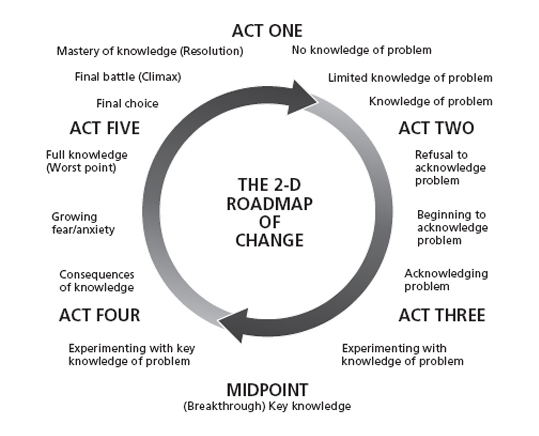
So like, hopefully this will get some of you guys started and isn’t too much of a spoiler, but for example I’m pretty sure the “problem” at the center of the 2-D diagram is none other than the final problem, i.e. “stayin’ alive.”
Diagram from John Yorke’s ’Into the Woods’ (classic book about narrative structure).
I’ve read a lot of excellent analysis of Sherlock, but none that explicitly addresses narrative structure in terms of acts. If we assume each act is a series, and each episode is one step within each act, this does seem to fit with Sherlock falling in love with John. (The use of ‘problem’ is unfortunate terminology in this case, but if we consider that Sherlock sees emotion as abhorrent, then it is a ‘problem’ in that sense. Bear with me.) I’m not suggesting that the writers have deliberately explicitly followed this structure (Moffat has said he hates discussing structure and just tells the story), but that (as Yorke explains) good writers cannot help following this structure because THIS IS HOW STORIES WORK.
Anyway.
Act/series one: from no knowledge of what love feels like to a knowledge of it as he and John meet and become close, saving each other’s lives.
Act/series two: from a refusal to acknowledge that he loves John (separating himself from him physically frequently in ASiB, eg the hitchhiker scene, Battersea Power Station where he is present but unseen), to an acknowledgement of it (TRF).
Act/series three: Experimenting with the knowledge – testing out John’s feelings (eg in the tube carriage in TEH), key knowledge about John (take your pick from everything in TSoT), and experimenting with key knowledge of problem (making sacrifices for John and Mary).
Act/series four: Consequences. Fear. Anxiety. (All of which fits with what we’ve been told.) Full knowledge (an actual confession of love?). The worst point (Mary-related? Moriarty? Mycroft? All of them? Gaaaahh).
BUT…
Act/series five: Final choice (John vs some major aspect of The Work?), final battle (Moriarty/another antagonist kidnaps John, perhaps?), then mastery of knowledge (canon Johnlock relationship, throwing of confetti, uncorking of champagne, much merriment throughout the land).
If anyone has more on this idea I’d love to read it.
Tagging a couple of excellent people below for your thoughts if you’re interested.
I entertain the thought that it was read backwards because what we are ‘shown’ is actually Sherlock’s recollection. It’s the recurring dream he tells Ella about, so the show is actually Sherlock’s ‘version’.
I have no fucking clue and I’ve come to terms with that
I still think this is a clue to missing footage. Reading it backwards or forwards shouldn’t have made a difference if what we were shown were the entire story, except to spoil the Norbury plot. And besides the E storyline, the episode we saw actually suffers from being too straightforward: on the surface, it’s action-driven, without much nuance.
I’m still leaning towards John having been shot at the end of TST; if they started with the shooting, then seeing the cover-up story unfold afterwards would make more sense. We only got to see it forwards, with no reveal at the end; that’s exactly why it made no sense to us.
Also, they may have had to explain the structure of the entire 4th series at that readthrough.
The actors get the scripts beforehand, and read them at home. If they were suddenly asked to read them backwards at the table reading, that indicates to me that the content and context were different from what was on the pages they received initially.
I interpreted Mark to mean that they did the week backwards, that they started filming before they had the read-through. That was what was backwards. No?
I think they really read just the script backwards. Filming 1st without a read through is unheard of, especially for Sherlock. Sources:



 Sherlock Fandom Archive