Serial Killers Sherlock playing with his own death… …Only for John to save the day
If this is reality, the writers are trying to make or close some sort of loop. Perhaps this is going off of the theory that suggests that Sherlock Holmes and John Watson will forever be stuck in a time loop. Their stories will never truly end as more and more film, book, and tv adaptions are made.
If this is in Sherlock’s mind, he’s subconsciously replaying he and John’s first case together.
[This is not my original post but I just added text to sound smart lol]
– Four agents from an independent organization, and a mistake, start the plot (AGRA’s problem). Ultimately, the organization is betrayed by one of their number. One agent will die years later, because of a plot surrounding biological weaponry (THoB anti-personnel formula caused hallucinations and murder without remorse-solution hinges on cell phone-same happens with formula devised by Valentine’s company in K: TSS, w/cell phone being method of control. Maybe TD-12).
– The mistake occurs around Christmas, and will change the hero’s entire life. (TAB: Take care of him, John. TFP: Oh, um. Mycroft – make sure he’s looked after. He’s not as strong as he thinks he is.)
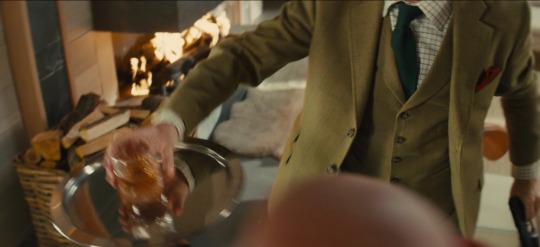
– Rescue the drink before it can fall to the floor, resulting in good guy being distracted.
– The villain never does his own legwork, because he has no stomach for violence (sight of blood causes him to vomit.)
– Umbrella gun (Brolly gun with updates – replacing meta from feb about Avengers, etc)
– Projections are treated like people in the room.
– Failed experiment in changing to more emotion in the group leads to a team member being decimated.
Eurus: This is an experiment. There will be rigour. Sherlock, pick up the gun. It’s your turn next.
And then later, she tells Sherlock he didn’t win, look what he did to Molly.
– An innocent child caught in the schemes of adults.
– Completely over the top driving scene, and lots of blue flashing lights.
– MET officer is same actor (William Ineson) as TFP fisherman.
– Placing a mysterious phone call changes events.
– Hero was involved in drugs, never had a traditional job.
– Insert inappropriate (gay) humor. “Manners maketh man…” from Vulgaria by William Horman. (SO many M’s.) Also, the first book where children’s rattles are ever mentioned.
–
A path that made the younger hero who he is, but he isn’t “locked” into
it. He can adapt and transform (even change his fate and take on
someone else’s identity.) + My Fair Lady bringing in play/film
reference, and Jeremy Brett connection.
– Surprise water! First test is near drowning. (Lesson is working together, being a unit. Soldiers.)
– Movie that breaks the fourth wall & Internet use. “Valentine: The Movie” (Valentine is a person. T6T Love, ammo not amo) & “Not
that kind of movie.” (John writing Cardiff Violins, Rosie’s birth
announcement in The Times, Janine’s interviews in HLV, BBC interview
w/Culverton, BBC covering Moriarty court case in TRF)
– Pet dog is major plot point, and makes Eggsy part of who he is, capable of being emotional and functioning as a top agent. (Redbeard)
– No concussion, but he’s unconscious? The other agents don’t know what he was exposed to, and the leader (villain) asks for footage. (Hello, EMP)
– “A gentleman is simply a patient wolf.” (Have patience, Watson. / Patience grenade)
– Again, the internet, but considering how much money they supposedly have, the graphics are very low-budget. Also, short-sighted? Description used for Mary in TEH. iPhones, for instance, don’t use separate SIM cards. (Post S4 crew explanations of the skull glowing due to blown light bulbs, etc.)
– Use the press as a cover for what really happened. (Magnussen in HLV)
“Foiled the assassination…” Eggsy jokes how probably no one thanked Harry for doing that.
– Bond style cavernous installation with top security that should be run “by someone responsible and sane”, because “bad shit happens if this falls into the wrong hands”.
– Hero that collects butterflies and insects being called a freak, by someone that doesn’t understand him yet. Also, we’re back to the situation with the dog not being what it appears. Turns out, the gun had a blank bullet (not a tranquilizer, but you get the idea.) Also, the recruit that supposedly drowned in the first test, was actually a field agent who lived, and works in the Berlin tech dept.
– You can’t hack pen and paper. (Unlike T6T Magnussen footage, and who knows what else in S2-4).
– The suit is a modern gentleman’s armor. (Adding a Belstaff is a nice tough, though.)
– Lock & Co. Hatters save the day. (Nice top hat and presumable projection glasses-Google specs?) Also, let’s have the media tycoons share the same shapes and color scheme of blue, with punches of beige and red.
– Old money, and keeping up old traditions leads to problems and weakness.
– Money and intelligence doesn’t have to equal being pretentious.
– The need for coordinates that are going the same way.
– Elaborate bunker with many minions (standard Bond film setup)
– A plane that can’t go much of anywhere or put up a defense. (It becomes just
a plot device, a vehicle with a different purpose than transport.)
– M (Merlin) played by Ritchie Holmes actor Mark Strong – he was Blackwood. Solve problems under pressure, when one member of the team might die. (TFP)
– Merlin gets nicknamed Mycroft.
This one has been awhile in coming, but… I may have missed a few things, but I think you get the point.
john bleeding out being like: those holmes boys are extra super straight and extra super smart and like to wear old creepy men disguises because i said so
This episode was once again written by Steven Moffat and directed by Rachel Talalay, who also directed Sherlock’s The Six Thatchers.
Missy and The Master circling The Doctor, asking how many times and ways he has died: “Have you burned?”= Moriarty saying “I will burn the heart out of you” in The Great Game. “I know you’ve fallen,” obviously ties into the title The Doctor Falls– and Sherlock of course has literally ‘fallen’ in The Reichenbach Fall. And The Master’s last quip:“Have you ever drowned?” makes me think of the original ACD canon, and Holmes and Moriarty plunging into The Reichenbach Falls. (And “drowned Redbeard” in The Final Problem…)
An even more explicit callback to The Reichenbach Fall and Sherlock falling off the roof of St Barts with Missy saying to The Doctor: “We might just chuck you off the roof.”
Missy says of The Doctor: “Love it when he’s Mr Volcano” when he is ‘internalising’ his emotions. See this quote by Steven Moffat:
“Sherlock Holmes, again, must have sexual impulses. (…) The fact is, he decides to put all that in an iron box to make his brain work better. He wants to rise above us like a snowcapped mountain, but he’s actually a volcano, and that’s where the story is. That’s where the story is.”
The Master asking the Doctor “What have we missed?”= Moriarty asking Sherlock “What have I missed?” in The Reichenbach Fall.
The Doctor saying that Bill’s mind is acting like a “perception filter”, and it’s so strong that it’s ‘built itself a castle.’= makes me think of the theories in The Final Problem of Sherrinford symbolising John’s mind in turmoil/lockdown as he lies there, shot.
“Where there’s tears, there’s hope….” [insert John crying in Sherlock’s arms in The Lying Detective]
Missy once more uses an umbrella as a weapon like Mycroft does in The Final Problem.
The Doctor saying “You can always fool a monkey brain with a little bit of theatre.”= there is a lot of misdirection in Sherlock, like sleight of hand in magic tricks, to distract the audience- and for a more literal take on ‘theatre’, see: Sherlock Series 4 as “Epic Theatre.” & this Moriarty ‘Applause’ addition.
A weapon used against the cybermen is an apple= Moriarty carving ‘IOU’ into an apple in The Reichenbach Fall.
Missy shaking hands with The Doctor even though she’s telling him she will not stand with him, but she’s disguising her true intentions… hello, Misleading Handshake Hell, WE HAVE A SHERLOCK COUNTERPART FOR YOU 😉 See this (pre-series 4) post by @waitedforgarridebs on a “deleted” handshake scene between Moriarty and Mycroft.
Missy and The Master killing each other in front of each other… ahem, to quote Steven Moffat on Sherlock and Moriarty: “Do you think they went up on that roof and faked suicide at each other?!” 😉
I’ve so enjoyed writing up all my posts for this series, and thank you all for reading, hope you’ve enjoyed them! I’ll still be doing the same for Christmas… once more unto the breach, dear friends. 😉 ❤
Please have a look at this. I actually wanted to make screenshots of the end of ASiP and compare it with the above scene from TFP. And then I realised that the pilot ending is much more similar to TFP than the end of ASiP. Here TFP serves as a mirror to the pilot.
In the pilot and in TFP we get Sherlock, John, and Lestrade talking to each other.
In the pilot we get Sherlock wearing the blanket when talking to John. In TFP we get John wearing the blanket when talking to Sherlock.
In the pilot Sherlock is still wearing the blanket when walking away with John. In TFP John is still wearing the blanket when walking away with Sherlock.
So they are going back to the very beginning here, not in an identical fashion but with changes roles. Interesting. And they did not go back to the first official episode but to the unaired pilot. Which, for some unfathomable reason, is affectionately known as the Gay Pilot.
Ahhhhh …. I love this comparison @gosherlocked . The end of TFP is so obviously connected to the PILOT. But with switched roles regarding Sherlock and John (and why did they do a panel for the PILOT last year at SHERLOCKED?) I wonder what all that might mean. There is still a lot of thinking and digging to do with this show. Brillilant find!
It’s actually quite sad because the besotted looking at each other is clearly missing- for reasons, I assume.
Actually, and I hope it’s okay that I join in on this conversation (as it’s about something I feel very strongly about but rarely have a chance to discuss), I have always thought that the writers of Sherlock put the titular character into situations with a high potential for sexual violence quite often. Arguably, most of those had been done on a thin line between subtext and text, i.e. not necessarily ‘in your eyes’. But still.
For example:
In the unaired Pilot, the cabbie crudely remarks to drugged Sherlock (who is placed by the camera eye in an extremely vulnerable position: the underwear shot in 221B, you know which one) that he could do whatever he wants to him at the moment but he is only going to kill him. The suggestive possibility of Sherlock’s becoming a victim of sexual violence could not be clearer.
In ASiB, the subtext becomes text when Irene drugs and beats Sherlock without his consent. Outside of the particular context of the scene, beating can be deemed a non-sexual form of physical violence, but Irene being a dominatrix (=sex worker) whose job is to provide ‘recreational scolding’ to those interested makes the act sexual. And unwanted on Sherlock’s part. Later on in the episode, when he wakes up at home, disoriented, he looks shaken and violated. The camera is not shy to portray his vulnerability in full yet again. Yet, Moffat being himself, never followed through with the consequences of this episode in Sherlock’s life. This plot line could have had the potential for viewers to think against the stereotypes and consider that sexual assault does not always have to involve what is commonsensically thought of as ‘sex’, but instead it was played out for laughs (Lestrade filming drugged Sherlock and enjoying the situation just like a good bro would). How after all that Sherlock ended up taking a liking to Irene remains a mystery to me. I am not even going to mention the rest of the episode, what with Irene stalking/texting Sherlock, breaking into his flat, taking his clothes, etc.
In TEH, we have the Serbian Basement Torture Fun for the Whole FamilyTM, also known as the scene that launched a thousand of non-con headcanons about Sherlock’s post-Reichenbach time away. My reasoning might be circumstantial, as it’s unclear whether it’s possible to deduce the subtext or authorial intent from fanon, and I personally don’t have such headcanons, but the sheer number of them and the fact that many fans saw the scene and read it in that particular way suggests the possibility of Sherlock (vulnerable and somewhat feminised, with long hair) being put by the writers in yet another scenario with sexual violence looming on the horizon.
Then, HLV presents us with the Magnussen in the hospital scene, removed from the final cut and later released on DVD (I wish they’d better released the gay bar scene but alas). I don’t think I need to prove the authorial intent and non-con (sub?)text in this one. Admittedly, it had been deleted from the episode and hence exists somewhere in between canon and apocrypha, next to the Pilot, but imho it doesn’t change much re: my initial argument about Sherlock and sexual violence.
In TLD, finally, another subtextual nod to Sherlock being vulnerable to potential sexual violence is the moment when Smith attempts to smother him in the hospital bed. A lot has been written about it already, and I don’t think I need to reiterate other smart people’s observations about the highly sexual atmosphere of the scene. That Culverton Smith is a bowdlerised stand-in for Jimmy Savile, a known sexual predator, doesn’t help much either.
TL; DR: Sherlock is different from many other mainstream TV shows in that it often, albeit subtextually, hints at sexual violence as a possibility for its male protagonist. I don’t know why the writers thought all these hints and suggestions were necessary. Perhaps, as a gay man himself, Gatiss is more sensitive to sexual violence against men. From his perspective, the possibility of such violence to lurk in the shadows of the protagonist’s character development could be more real. After all, to some creators, it is not a thing at all; stereotypically, sexual violence in media is ‘reserved’ for female characters while male characters get non-sexual whump. Yet, I also would not attribute any heightened enlightenment to him in regards to the gravity of the topic. Perhaps, Gatiss uses sexual violence against men as a plot device. Just like gay jokes.
This this this. I was chatting privately to @plaidadder about how I wanted to write a response like this but was at work when I read the OP, but now you’ve gone and written it and I don’t have to 🙂
But yes, as someone who is a sexual assault and CSA survivor who reads a fair bit of Sherlock non-con, one of the reasons why I identify with Sherlock so strongly as a character and have written him in these situations, is because it is easy to imagine him as a survivor due to his having been placed in to so many canonically violent scenes with sexual overtones.
As to @plaidadder‘s comment as to why it’s always Sherlock and never John who gets beaten, I would say that it is in part because that violence is frequently sexualized and the show does not invite us to view John as an object of predatory desire quite the way it does Sherlock.
Perhaps, Gatiss uses sexual violence against men as a plot device. Just like gay jokes.
I think that this remark was a bit harsh; I’m super wary at the way the fandom vilifies Mark Gatiss because it feels like he is particularly being singled out because he’s gay.
That said, I do think you have a point about the creators making light of the sexualized violence against Sherlock. Here’s an excerpt from Arianedevere’s Empty Hearse Transcript:
Well. That is a large question. But I am here for it!
First, for those just joining us I assume you’re referring to “An Open Letter to Vince Gilligan, Or, Get the Hell Away from Me With Your Scully Torture Porn,” my initial and somewhat visceral response to the season 8 X-Files episode “Roadrunners.” In it, I mention that several otherwise excellent Vince Gilligan episodes maneuver Scully into a position where she is unable to defend herself against sexual and/or sexualized violence (“Small Potatoes,” “Bad Blood,” “Three of a Kind”) because she’s impaired in some way (repsectively: alcohol, chloral hydrate, some kind of drug that interferes with cognitive function and turns Scully “into a bimbo”). “Roadrunners,” instead, has Scully overpowered by mob violence, so what used to be a scenario with overtones of date rape now becomes a scenario with overtones of gang rape. My point is, that in Scully’s case, I don’t think you can separate this trope from rape culture, and indeed on rewatch I was struck by how often rape narratives manifest either explicitly or subtextually in X-Files episodes. There are, for instance, at least two episodes I can think of right now in which we are asked to sympathize with a villain who has raped women by having sex with them either while pretending to be someone else (Eddie Van Blundht in “Small Potatoes”) or while the victim is unconscious (“Post-Modern Prometheus”). I also think that Scully may actually have been raped by the sheriff in “Bad Blood,” though of course that is debatable.
Anyway, my point is that I think Scully’s torture on The X-Files is often (though not always) focused through the almost entirely male writing team’s fascination with her femininity and especially, for Chris Carter, with her fertility (something I would argue was cemented for him when he created the abduction arc to cover Gillian Anderson’s actual pregnancy-related absences in Season 2). So this makes it, to some extent, different from what’s going on with Sherlock in the post-Reichenbach Sherlock. With the possible exception of some parts of “The Abominable Bride” (and then only if you go pretty deep into the Freudian reading), Sherlock’s torture is not about rape and of course it can’t be about his pregnability, except of course in the Omegaverse.
However, the common denominator there, as in many texts that use protagonist torture (torturing the villain is sort of a separate case, if I get started on that I will be here all day), is vulnerability. One of the major narrative purposes for protagonist torture is to establish the magical blend of strength and vulnerability that people tend to find appealing in a protagonist. In the case of The X-Files, again, the unsavory “we must prove that Scully, while smart and competent, is nevertheless still a ‘real woman’ by making her vulnerable to male predation” narrative is always lurking beneath (in, for instance, “Irresistible,” “Don’t Look Any Further,” “Milagro”). But in the case of Sherlock, you do have a version of that unsavory narrative, which is, “we must prove that Sherlock, while highly intelligent and socially awkward, is nevertheless a ‘real human.’”
Protagonist torture can also be used for other purposes: 1) to justify or explain a bad thing the protagonist is doing/will do as a result of being tortured; 2) to externalize the protagonist’s struggle with his/her inner demons; 3) to establish how evil the villains are; 4) to generate sympathy or provide a redemptive narrative for a character who has Failed or Sinned or Been Weak; 5) to increase the viewer’s distress and anxiety, thereby making the show more compelling 6) to stimulate the viewer’s sensory responses, thereby making the show more compelling.
Some observations on protagonist torture in Sherlock:
* John and Sherlock both go through their share of torment, but for John, it’s almost always psychological, as in “Hounds of Baskerville.” It’s striking that in all the pre-Reichenbach situations where John is put in peril, we never actually SEE the villains subduing John physically–something which certainly must have happened, but is never shown, in “Blind Banker” (John gets the door thinking it’s the Chinese food…then he and Sarah are tied up in an underground tunnel) and “Great Game” (where John suddenly appears wearing a bomb that Moriarty has strapped to him, without any explanation of when or why or how that happened). Post-Reichenbach we do see how he gets into his predicaments but it always involves a nearly-painlessly administered tranquilizer of some kind (“The Empty Hearse,” “The Final Problem”). Except during free-for-all fight scenes, such as in “Blind Banker,” John never gets physically brutalized on screen.
* Sherlock, on the other hand, endures a lot of on-screen physical violence. He’s nearly killed in the flat in “Blind Banker” (while John rants at him obliviously from outside). John punches him several times in “Scandal in Bohemia,” in which Irene Adler also beats him pretty viciously with a riding crop. At the beginning of “Empty Hearse,” we (and Mycroft) watch him being beaten severely in a Serbian prison. He is slapped by Molly and then of course SHOT IN THE CHEST by Mary in “His Last Vow,” then kicked around pretty hard by Ajay in the pool fight in “The Six Thatchers,” and then beaten to a pulp by John in “The Lying Detective.” Now some of this is probably because Sherlock is the detective and he draws a lot of adversary violence, and probably because Cumberbatch at this point has a lot of action movie skills and is more credible in combat scenes. But that doesn’t explain all of this.
* Interestingly, the two episodes built around Sherlock’s psychological torture– “The Reichenbach Fall” and “The Final Problem”–are the two that are most “humanizing” in that they show him expressing genuine, intense, uncontrollable emotions, including fear.
The conclusion would seem to be that Moffat and Gatiss beat up on Sherlock more than they do on John, and that they do it because it is in some way satisfying to them, or because they think it’s satisfying to the viewers. “Scandal in Belgravia” is very telling that way, in that both John and Lestrade confess to a chronic, barely suppressed urge to “punch [Sherlock] in the face.” Moffat, at least, seems to imagine that any man who has to deal with Sherlock for any length of time will want very badly to beat him up. For Moffat I think this is about masculine competition; he assumes most men will be so angry at not being the smartest and bossest guy in the room that it will give them the urge to attack the alpha dog. And in fact, the other men in Sherlock do seem to enjoy hazing him, insulting him, and generally dicking Sherlock around. There’s the unauthorized search of 221B in “Study in Pink,” Lestrade filming Sherlock while he’s on Irene Adler’s crazyballs drugs in “Scandal in Belgravia” (and no doubt putting it on YouTube), all the razzing about him not knowing about the solar system, and so on. All of the male-male relationships involving Sherlock have an antagonistic streak, including and especially (and especially in series 3-4) his relationship with John, which occasionally becomes violent.
Torturing the protagonist is a reliable way of generating intense emotions in the viewers. The fact that these emotions are often intensely negative doesn’t matter in terms of how powerful the viewing experience is. Humans enjoy stimulation, even when it’s horrifying. This is why horror is a genre; it’s why “Chain of Command” and “Plato’s Stepchildren” are Star Trek fan favorites; it’s why hurt/comfort and whump exist.
But that doesn’t explain why, when it’s time for an actual beating, it’s always Sherlock and never John. What does explain that? I can see numerous possibilities, but I have to go to lunch, so I will be forced to leave this here for now.
(In the place where Sherlock is tortured) MARK: This is actually in the basement of The Diogenes Club – same location. It’s not meant to be! STEVEN: Which is strangely believable, plot-wise! He just kept him down there … MARK: … like in The Ipcress File. STEVEN: Mycroft’s personal torture chamber. He locked up his brother for two years for fun, and burnt him with cigarettes!
[…]
(As Mycroft whispers in Sherlock’s ear) STEVEN: It’s Mr Sex. I’ll get it in. UNA: There he is. STEVEN: Look at that sex hat. ‘S-hat’!
MARK: All those things that went in the online prequel [Many Happy Returns] were sort of where Sherlock might have been in the intervening two years, but none of it’s absolutely accurate. It’s still from Anderson’s point of view, so who knows? STEVEN: But that was originally part of the episode, wasn’t it, and then we got rid of that. MARK: Essentially, it was taking too long to see him again. In the original story, The Empty House, Conan Doyle sort of had the same problem, which is that you just want them to be back together again, and in the end the explanation is nowhere near as important as the fact that they’re back together again … Your Honour! (As the car pulls up outside The Diogenes Club) STEVEN: He’s being driven round the front of the place where he’s been imprisoned! MARK: Mustn’t start that – people’ll start to believe it! STEVEN: I believe it now – it’s part of my head canon, as they say. He was just in Mycroft’s basement, and [Mycroft] was saying, ‘Try waterboarding, and give me the video.’
Actually, if you look at the transcript, it looks like Moffat is pushing the Holmecest non-con torture interpretation even more than Gatiss. But more importantly, I think the transcript tells us that they know exactly what kind of overtones this scene has, and that they put them there deliberately.
Tumblr being tumblr, I feel compelled to add that saying that I think the creators knew that there were sexual overtones in this scene doesn’t mean I’m saying Moftiss admitted that Holmescest is canon though I do in fact think Holmecest is canon.
I also feel compelled to add that I don’t equate Moffat and Gatiss joking about Mycroft torturing Sherlock, who is of course a fictional character, means that they are making light of actual torture, or male survivors of incest or other kinds of sexual violence.
But I do think that those of us who wrote all the fics which were launched by that scene weren’t imagining things. Those overtones were there, Moftiss knew what they were doing, and I think that they clearly enjoy a bit of Sherlock whump themselves. I mean, Gatiss wrote the words into Sherlock’s mouth: “You were enjoying it. Definitely enjoying it.”
This is such a great discussion. Where does it leave us with John beating up Sherlock in TLD? Is that also sexualized violence, fuelled by John’s fear of being identified as ‘gay’? Therefore, the only way for him to touch Sherlock is in a violent way? Like he does repeatedly in TEH, as some kind of welcome back, and very brutally in TLD, there even connected by text with the death of his wife (heterosexual sex partner). Is he using Sherlock here as a substutite for Mary, exchanging the only kind of intimacy he feels allowed to with a man?
No wonder all those dark, abusive headcanons sprang up after S3 and TAB (”What made me” – Moriarty fellating a gun). The waterfall scene is another example of sexualised violence. All those wet male bodies writhing on a literal edge… Sherlock being beaten up by his utmost fear. Like many survivors do every day.
I have, for years gotten a strange feeling from the way Gatiss talked about Ben at some cons. He seemed to enjoy making digs about him, needling him. Moffat, not so much, but he has made comments on his lack of looks compared to Ben’s. If as was said, men’s aggressive, negative reactions to Sherlock reflect how the writers feel men are, that group of men might also include themselves, the writers. Just a thought. Dark, I know, but we are all human. The writers, while accused of not getting inside of the characters, definitely put a lot of their own personal ‘stuff’ into BBC Sherlock.
The through-line of non-consensual sexual violence against Sherlock is so consistent, and started so early, that I have to respectfully disagree that there will be no consequences. Of the recurring themes introduced in the pilot, I think that only suicide and romance are more frequently touched on. The fifth series will most certainly resolve this arc along with all the others. I don’t believe for a second that the writers create these scenes unconsciously (as Chris Carter did with Scully), although I’m sure @tendergingergirl‘s observation about “personal ‘stuff’” is apt.
Some of my earliest encounters with Sherlock Holmes as a character were in non-Doyle stories, like those by Nicholas Meyer, and they all seemed to be quite heavy on Freudian themes. For that reason, I’m never surprised to see Sherlock returning to these darker ideas. Moffat, in particular, has a penchant for taking quite grim ideas and dressing them brightly. I know it’s the popular thing lately to say he does this because he is frivolous, but I think he does it for exactly the opposite reason. The uncritical viewer gets walloped when they realize that they’ve been “laughing at the funny torture joke”. It’s the same thing Derren Brown does with some of this illusions.
This kind of irony is particularly appropriate in a series like Sherlock, where the casual viewer has very specific and rather inaccurate expectations of the character.
We know that Moffat and Gatiss
want to correct those expectations. They want people to think about what’s happening on the screen – are they reacting to what they’re actually seeing? What are they missing by filling in the gaps with their expectations?
We see the same thing with how some segments of the audience react to Mary shooting Sherlock, or Sherlock’s entire “relationship” with Irene Adler, for example. It’s a technique
used
quite consistently on Sherlock, and it will eventually come with a payoff. They’re just not done yet.
RB for discussion.
Again, also, wth does TAB mean in the scheme of this crazy show? At the TAB waterfall, John pretty clearly stated that he was there to save Sherlock from sexual violence (finds your attention a tad annoying wasn’t subtle). So whatever their reasons for repeatedly setting Sherlock up as a sexual victim, they also (at least in TAB) placed John as his savior. (As they have placed him as his savior from other suffering more than once) TLD made zero sense.
I am so glad you asked this question, 1895itsallfine, because I have been waiting for an opportunity to rejoin the conversation with this:
I found TAB very interesting so I wrote a shit-ton of meta on it, including the above-linked piece about why there is so much beating going on in it. It included this passage, which now seems prophetic to me:
We’re going to find out that Redbeard is not just the name of Sherlock’s dog. And my guess is that Redbeard, in one way or another, is going to turn out to be the answer to a question that “The Abominable Bride” poses:Who hurt Sherlock?
…
My point is: when Introject John is probing Sherlock about why he’s ‘always alone,’ he says, “Who made you this way?” From a therapist (which is how Introject John is acting right now; everyone in this episode gets to analyze Sherlock, just as everyone in the HLV mind palace gets to help him survive the shooting), that could mean a lot of things, but certainly it could mean, “From what you’ve told me so far I’m pretty sure you’ve experienced some kind of abuse.” Sherlock denies that anyone “made” him; but then he goes into that little trance state again, and right before the Bride reappears, he murmurs, “Redbeard?”
So I don’t know who or what Redbeard is. But I do have a strong suspicion that all y’all who have been cherishing Sherlock-as-a-survivor-of-childhood-abuse headcanons may be vindicated this year.
As we now know from “The Final Problem,” this prediction was accurate in substance if not in the details. I couldn’t have ever imagined the ridiculous ways in which they made this come true; but in fact: 1) Redbeard is not the name of Sherlock’s dog; 2) Redbeard is the key to the answer to the question “who hurt Sherlock?”; 3) Sherlock is certainly a survivor of emotional abuse and, given Eurus’s well-documented passion for vivisection, probably physical abuse as well.
As for Moriarty’s role in TAB: upon further consideration I am persuaded by heurtebizz and anarfea’s arguments about Sherlock’s torture as sexualized violence. I was obviously too quick to dismiss the possibility that he and Scully might actually have that in common. (BTW, Mulder also gets tortured in The X-Files, especially after his abduction in season 7, but probably best not to go down that sidetrack right now.) Also I failed to recall the fact that one of the things straight men most fear about gay men is that the gay men will treat straight men the way straight men treat women, and that sexual violence is one of the ways in which men figuratively and literally assert dominance over each other. But anyway, my point was: this subtext does in fact come very close to the surface in TAB because of Moriarty, who does indeed (as 1895itsallfine points out) constantly threaten Sherlock with “attentions” from which John ultimately protects him (I talk about this in The Reichenbach Retcon).
Anyway, TAB, as an episode where Gatiss obviously felt at liberty to do whatever the fuck he wanted, is probably your best bet in terms of insights into what he’s doing with all this.
I also think all this sexual violence towards Sherlock is meant to shine a light on his innocence in that area which has been mentioned many times on the show. Perhaps past abuse is what the writers are using as a reason for Sherlock’s reticence about relationships and sex and why he seems to have divorced himself from his own body. Sherlock has, for some reason, decided that his body is just transport and so has willingly denied himself its pleasures. Not only sex, but also food.




 Sherlock Fandom Archive