First, falling from a cliff… then a face moving back and forth in the dark, suddenly appearing in another spot… the frozen certainty that something unbearable is about to happen: this dream has haunted nineteen-year-old Meg for ten years, ever since she went to live with her unfeeling English father after her mother’s death. “
I’ve been deaded along with most of the rest of the fandom, so I haven’t done much of my own writing on the finale. Howeverrrr, Louise Brealey’s tweets in response to Steven Moffat’s interview with EW got me going, and, alas, here we are. The first half of this piece has been published on Bustle, but I had to cut it significantly, so I’m posting the extended version here.
In “The Final Problem,” one contentious scene stood out among the many, many, many (Tumblr is making lists) other contentious parts of the episode: the forced love confession scene between Sherlock Holmes and his pathologist friend Molly Hooper. The scene – which was actually a last-minute addition to the script – has polarized the fandom because it seemingly reduces Molly to a one-dimensional, love-sick sop, while proving to Steven Moffat’s staunchest haters that the “Sherlock” writer and creator is a diabolical misogynist.
On the Steven Moffat front, I happen to love his female characters. Even when I hate them – cough Clara Oswald cough – I love that I hate them, because it demonstrates that they’re real and layered enough for me to approach them in an ambivalent way. Molly Hooper is actually one of Moffat’s more complex female characters, both in personality and narrative arc – the latter of which is why people are so irked by the Molly Hooper scene. I have other problems with the scene (which I will get into later) but I do not think it necessitates a reductionist view of Molly’s character, despite the implication that Molly has not progressed past her season one self.
Molly starts out as a Sherlock fangirl of sorts, fostering an unrequited affection for the great detective. In season two, we learn that she is more than her love for Sherlock – she stands up to him, gains his respect, and becomes an integral part of Sherlock’s plan to fake his death. Season three moves her further into the friendzone (which, in the context of the “Sherlock” universe, is a huge step for both of them), while establishing that she has – or tries to have – a life outside of the pathology lab and the morgue.
Her character in “The Abominable Bride,” is the most interesting: “Molly” is known to all as “Hooper,” the “man” who runs the morgue and takes no shit from anyone, least of all Sherlock. When we find out that the whole plot of “The Abominable Bride” is a fiction concocted in Sherlock’s head to help him figure out a case, it makes Molly’s re-characterization as a man even more fascinating – not because Sherlock would only respect her as a man, but because he now recognizes her inner steel, and believes that if Molly did live in those more, ahem, genteel times, she would have had to pretend to be a man in order to be respected as the smart and capable person that she already is.
Season four shortchanged a lot of characters, Molly included, and she only appears in the first two episodes to help take care of John’s baby and to remind Sherlock that he’s too doped up to function. Then came “The Final Problem.”
“The Final Problem” centers on the sudden, psychopathic appearance of Sherlock’s secret sister, Eurus, and her desire to understand Sherlock’s “emotional context.” To do so, she puts him through a series of Escape Rooms and presents him with a different ethical conundrum in each. One room contains an empty coffin, which Sherlock deduces is meant for Molly Hooper. Eurus tells Sherlock that Molly’s flat is rigged with explosives, and unless he can convince Molly to say the code phrase “I love you” before the timer runs out, Molly will die.
It’s cruel. In a way, that’s what makes the scene brilliant. For Molly, it’s a painful phrase to utter “because,” she says, “it’s true.” And even though Sherlock succeeds in the challenge – “I won! I saved Molly Hooper!” – the cost is high, and, Eurus explains, unnecessary. Eurus reveals that Molly was never actually in any danger, so Sherlock hasn’t actually “saved” her, and whatever he thinks he has “won,” he’s now lost much, much more. “Look what you did to her,” Eurus points out. “Look what you did to yourself.”
“Look what you did to yourself”:
Immediately afterwards, Sherlock Hulk-smashes the coffin with his fists in a primal rage, an indication that, as the entire series thus far has aimed to show us, the most impressive aspect of Sherlock Holmes is not his brain, but his heart. Sherlock is deeply, deeply emotional, and it’s gut-wrenching to see him so distraught over causing emotional harm to someone else, someone he used to slight without a moment’s hesitation or afterthought. Now that’s character growth. Plus, this scene is a callback to “A Scandal in Belgravia,” when Sherlock humiliates Molly at a Christmas party, completely blind to her affection for him. Sherlock is surprisingly chastened when he realizes his mistake, and the moment marks an important crack in his emotionless facade.
The scene in “The Final Problem” is so agonizing because we know how much Sherlock has grown since then. But what about Molly? It seems she hasn’t changed a bit. In “A Scandal in Belgravia,” Molly plays the part of the pining, unrequited lover, and she is thrust into the exact same position in “The Final Problem.” Many fans are furious over this static characterization of Molly, a woman who seems to exist only to support the emotional growth of the main, male character. In fairness, the show is called “Sherlock,” ergo, every character – male or female – essentially exists to support the emotional growth of the main, male character. However, is it fair to say that this scene indicates that Molly is nothing but a stock female character with no internal growth or struggle?
Yes and no. No, because Molly is far from being a prototypical damsel in distress of yore or a one-dimensional, ass-kicking heroine. In fact, what I love most about Molly Hooper is that she turns the dreaded trope of the Strong Female Character (™) on its head. Here is an original female character (she does not appear in the Arthur Conan Doyle stories) who is pure-hearted yet complicated, emotional yet entirely competent. Though she has some form of a relationship with the main, male character, she also has her own career, dating life, living space, and stressful days unrelated to said main, male character. What stood out to me most about Molly and Sherlock’s exchange in “The Final Problem” was Molly answering the phone with “Hello, Sherlock. Is this urgent? Because I’m not having a good day.” Those six words – I’m not having a good day – hint at an entire life outside of whatever’s going on with Sherlock Holmes, and imbue her character with immediate depth.
The fact that she is still pining for him arguably makes her feel even more real. In response to fan criticism, Louise Brealey tweeted her own assessment of the scene: “Loving someone after years is not reductive, retrograde, antifeminist or weak.” (The actress views herself as a proud feminist and has been outspoken about women’s rights and her own struggle with body image issues.)
All of which makes the fallout – or lack thereof – from this scene at the end of the episode so shocking. We see how this conversation has profoundly affected Sherlock (“Look what you did to yourself”), but not how the conversation has affected Molly (“Look what you did to her”). Molly appears in one subsequent scene in the episode, as part of an ending montage that shows her happily skipping into 221B Baker Street. Wait, what?
In a post-finale interview with Entertainment Weekly, Moffat addresses fan concern with the careless treatment of Molly in this episode with a repressive: “She gets over it!” He then goes on to explain that their resolution obviously occurs off-screen, and ends with: “She probably had a drink and went and shagged someone, I dunno. Molly was fine.”
Oh, Steven. If anything, this makes matters even worse, and Louise Brealey herself tweeted that she disagrees with Moffat’s assessment of Molly’s reaction to this scene:
The Molly Hooper scene in “The Final Problem” is supposed to feel horrible. It’s supposed to feel brutal, and it feels that way because of the careful development of both Sherlock’s and Molly’s characters over the course of the series.
We witness Sherlock’s agony, but Molly’s is completely brushed aside. That’s the real tragedy of the treatment of Molly’s character – not what happened to her within the “emotional context” of the episode, but what wasn’t explored by the writers afterward.
But there’s another ick-factor as well, and that’s the larger issue of the whole “no homo” feel of this episode. This scene bothered me on a more meta level because it felt like it was capitalizing on Sherlock’s one heteronormative relationship. If the words “I love you” mean so much, why not have Sherlock say it to John? (Sherlock himself says “I love you” to Molly because she will only say it if he says it first.) I could write – and obviously many of you have written – hundreds of pages on how Sherlock’s love for John Watson drives nearly every episode, so that’s another essay entirely. But if you’ll take it on good faith that Sherlock and John’s relationship is what powers the heart of the entire series, why have Sherlock utter such a sincere-sounding declaration of love not to John, not even to his brother Mycroft, but to the one straight female character on the show? (Apologies to Mrs. Hudson.)
BBC deliberately mislead fans by including Sherlock’s “I love you” in one of the promotional trailers for the season – and that, I believe, was cruel. Not cruel towards fictional characters, but cruel towards real-life fans who devote so much of themselves to this show. A large proportion of “Sherlock” fans were exhilarated by the prospect of seeing John and Sherlock finally get together as a couple, despite the fact that Steven Moffat and Mark Gatiss have repeatedly denied that that was ever going to happen. For my part, I didn’t need to see the two of them engage in a dramatic, public display of affection to close out the season, and I believe something that grandiose would have been out of character for these two emotionally repressive men.
But that’s why the final hug between Sherlock and John at the end of “The Lying Detective” was so meaningful and so cathartic. That’s why Sherlock saying “I love you” to or at John (hey, I would have been happy with a Mind Palace love confession too) would have been a natural follow-up to the emotional vulnerability finally laid bare at the end of “The Lying Detective.” And that’s why it felt so cheap to have Sherlock say it to Molly. “I’m not an experiment,” she angrily scolds Sherlock, as he desperately tries to get her to say those three words. But in the larger, “emotional context” of this show, she might as well be.
.
What a wonderful, balanced review of that scene! Covers some of the same ground as my post on the ‘I love you’ scene, but more broadly and thoroughly. It’s true that Molly– like Mary, too– ‘feels’ real in a really low-key and subtle way. I don’t think that it’s blatant, but moments like Molly’s not-so ‘good day’, or the way Mary told John in HLV that ‘you can’t go. I’m pregnant’. The moments of realistic portrayal and the often great performances exist in a rather stylized artificial world, however. As some people have said about Mary’s antihero portrayal, the over-the-top back-story can easily prove too distracting to appreciate the little touches.
I particularly appreciate the reminder of the subtle development Molly did have. Although she’s still a minor character who really didn’t have an arc, I feel that my earlier summary of her behavior through S3 into S4 wasn’t generous enough, as it lacked this sense of the necessary context of her overall shift into greater self-confidence and maturity. Of course, this show is well known for not showing explicit consequences for anything characters do, but particularly minor characters such as Mary, as Ivy described. It doesn’t mean it’s *okay* or anyone has to consider it ‘good writing’, but the implicit orientation of the narrative does seem to mean that one is meant to fill in the blanks between what we see and what ‘has to have happened’ in between.
Basically, I think you could argue that both Moffat and Loo could be right, in that Sherlock and Molly are okay by the end, but they weren’t *immediately* or automatically okay, and Molly didn’t somehow *magically* get over it. They must’ve had a conversation about feelings– and we know Mofftiss hate showing those if they don’t have to, even with the main characters– and it worked. Of course Molly forgave Sherlock if she really did love him, ’cause John certainly forgave him for worse things by far. Of course, YMMV as to whether that’s enough for you.
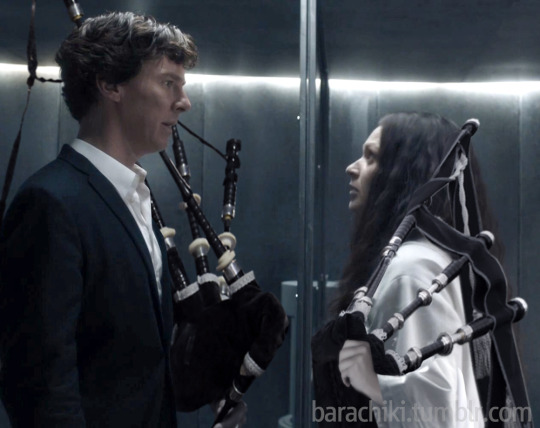
Omg! I always wondered how they did this scene, I thought it was cgi but the fact that it’s practical effects and Benedict went all in with it (literally!) I have so much respect for his dedication
Why I didn’t like The Final Problem #17382900979391988291911
BCC Sherlock is glorified fanfiction, and the summary read as “Me and my friends absolutely love Sherlock Holmes, and so we wanted to do a modern day AU, we’re going to try to stay as close to canon as possible while still updating everything.”
If I saw that on AO3 and decided to read it, I wouldn’t want to read a fic where an OC was a main character or the main villain, because they’re OC wasn’t in the original canon, and she wasnt advertised in the tags. I have no investment in Eurus or her modern day existence because she never existed in the first place and literally none of TFP felt like a tribute to anything ACD related.
Its like the fanfic wasn’t labeled right but i was still expected to enjoy it?
^This book in the centre with the gold lettering on the spine is:
The Eight, published December 27, 1988, is American author Katherine Neville’s debut novel. Compared to the works of Umberto Eco when it first appeared[citation needed], it is a postmodernthriller in which the heroine, accountant Catherine Velis, must enter into a cryptic world of danger and conspiracy in order to recover the pieces of the Montglane Service, a legendary chessset once owned by Charlemagne. (x)
The story follows two lives- one in 1972 and one in 1790 but both characters’ fates are connected. The most interesting part of the plot summary for me was:
In 1972, Cat Velis faces a similar atmosphere of conspiracy, assassination and betrayal. When she is requested by an antique dealer to recover the chess pieces, she unwittingly enters into a mysterious game that will endanger her life. As she learns the story of the Montglane Service, she begins to realize that players of the Game may plan their moves, but their very existence makes them pawns as well.
sometimes I’m like, what if the instrument both sherlock and eurus played wasn’t the violin but like… the trombone. or the recorder. or the piano, but sherlock can’t drag a baby grand out to sherrinford every time he visits, so he just brings a keyboard.
Whoever created this scene knows that, in the story, the thing was done, that it was done quickly, and that is was done specifically to John and Sherlock. Not to Sherlock and Mycroft.He turns his eyes to John. He does, and John sees. It’s only for an instant, a couple of frames, and then it’s back to Mycroft, but it happens.It took her five minutes to do all of this to us. To us, John.I’ve been meaning to make this gifset for a long time. It feels important.
In the last Sherrinford scene in The Final Problem, Mycroft admits that everything that’s happening is his fault, because he allowed Eurus 5 minutes with Moriarty. Here’s what happens as Sherlock prepares to shoot Mycroft:
He’s talking to Mycroft. Of course he is. And there’s no pause in the sentence. “To do all of this to us” all comes out, while his eyes are locked with his brother’s.
But then:
He turns his eyes to John. He does, and John sees. It’s only for an instant, a couple of frames, and then it’s back to Mycroft, but it happens.
It took her five minutes to do all of this to us. To us, John.
Whoever created this scene knows that, in the story, the thing was done, and that is was done specifically to John and Sherlock. Not to Sherlock and Mycroft.
I feel like I had an “aha!” moment. I might just be saying something everyone else has, and forgive me if that’s the case, but hear me out.
Prior to January 15th, we all thought Sherlock would confess his love to John during The Final Problem.
However, Sherlock couldn’t have. He still wasn’t ready for romance. How do I know this? The Abominable Bride told us so.
This postby jon-lox pointed out that the line “romantic entanglement” is very specific, and it occurs twice, first in the greenhouse scene from TAB:
John: Why do you need to be alone?
Sherlock: If you are referring to romantic entanglement, as I have often explained before, all emotion is abhorrent to me.
And then in TLD:
Sherlock: As I think I have explained to you many times before, romantic entanglement, while fulfilling for other people–
John: Would complete you as a human being.
Jon-lox’s post concludes that since these two big scenes were interrupted, since this entire conversation was aborted twice, it has to happen again, and on the third time, it will be resolved. I agree. It’s significant that those two scenes had very similar dialogue and neither conversation brought about any real change in Sherlock and John’s relationship. It leaves the audience yearning for something substantial to come out of Sherlock and John’s exchange, or else it feels kind of pointless.
But, I think a lot of us forgot about how the greenhouse scene concluded, and I believe it’s crucial. After going back and forth, Mind Palace John askes, “What made you like this?”
Sherlock responds, “Oh, Watson. Nothing made me…I made me.” Then, a dog barks, and he goes, “Redbeard?” But, the case picks up, and Redbeard isn’t mentioned again for the rest of the episode.
I think it is so important that Redbeard was included in this specific scene. The scene, of course, tells us that, although Sherlock is unable to recognize this on a conscious level, whatever happened with Redbeard is responsible for who he is today, which is later confirmed in TFP. This scene could have been placed anywhere in the episode, but Mofftiss chose to conclude the conversation about Sherlock’s love life in this way. Why?
The greenhouse scene, in its entirety, told us that Sherlock could not open himself up to emotion and romantic entanglement until he confronted the trauma that forced him to emotionally shut down in the first place.
Again, Sherlock could not make this conclusion about himself because the pieces were still missing with Redbeard, which is why the conversation is left hanging again in real time with John. I remember when TLD aired, I thought, “Why did Sherlock deny feeling romance again? What about the scene in TAB?”
Now, I realize that Sherlock actually couldn’t progress on this matter while there were still unanswered questions so deep in his mind that even his drug-induced dream in TAB couldn’t get to the heart of the problem.
Personally, I don’t have strong feelings about whether TFP is real or fake. I’m keeping an open mind to everything. But, whether Sherlock found out about Victor Trevor/Redbeard in real time or in his mind doesn’t matter. What matters is that Sherlock confronted his childhood trauma which made him (at least attempt to) divorce himself from all emotion. He confronted it, and he overcame it.
Where does this leave us? It’s simple: Sherlock’s ready now. When the third version of this conversation occurs, it will not be left hanging anymore. It will resolve.
I’m pretty new to the meta world and I would really love to get some opinions on this. I’m going to tag a couple blogs which immediately come to mind, and I hope I’m not bothering anyone! Everyone is free to comment on this, though. @inevitably-johnlocked, @tjlc
So I am to believe that a whole family played along with a man in his late thirties still believing that his childhood friend who was drowned in a well by a mentally ill sister in truth was a dog who had to be put down? And his brother not only going along with it but even encouraging him? Using “potential trigger words” to
“update” himself as to his brother’s mental condition? Preferably in a situation when he could be expected to be upset anyway – “Do you remember Redbeard?” This is just cruel.
I really don’t know what Mycroft (was it Mycroft who erased the memory of Victor and re-programmed Sherlock with those trigger words?) actually did. NLP? Did he somehow brainwash Sherlock? Or did Sherlock do this all by himself? But then, where would those trigger words come from?
And their parents – when Sherlock’s substance abuse went havoc with their line dancing, as it seems to have repeatedly been the case? They did nothing? Didn’t seek help for their son? Honestly, where would have been the harm if they’d told an adult Sherlock that he had a best friend as a child who’d vanished. (Because the parents can’t have known that Victor had been killed by Eurus, as his bones still remained in that well… I’m sure the dead child would have been exhumed if the parents had known where he had been). They even could have told Sherlock that he once had a sister, who burned down their house and died in a psychiatric clinic (btw, why isn’t Sherlock afraid of fire, only of water?) – as they believed was true. Sherlock deals with crime and death all his adult life – I’m sure he would have coped with discovering that he had had a friend called Victor as a child. And a sister. Perhaps he would have searched for Victor’s remains. But wouldn’t that have been way better than have Sherlock drift off into addiciton and suicidal thoughts?
And even Mycroft, who seemingly wanted to protect Sherlock from the drugs – why didn’t he insist on therapy when Sherlock was old enough to suffer from the suppression of his childhood memories and became a drug addict, because something was clearly missing in his life yet he didn’t know what exactly?
Ok, perhaps Mofftiss wanted to built towards the hero Holmes and only used the addiciton, like ACD did, to give Sherlock some kind of flawed past to overcome (though for ACD it was more the touch of the bohemian, showing him as something else than the calculating machine, to give the personality more depth)?
Perhaps to explore all those issues – trauma, drug addiciton, mental health, NLP, loss of a friend and sibling – would have been too much for a 90 minute story?
BUT WHY CHOOSE THIS STORY LINE IN THE FIRST PLACE IF THERE WAS NO ROOM TO EXPLORE IT IN DEPTH?
No one forced their hand.
There would have been so much potential if Mofftiss had decided to explore all this a bit more. But if you are just after the next shocking rug pull, emotional depth and making sense of a story can get in your way. Done like this, however, the climax felt half-baked, superficial and badly executed.




 Sherlock Fandom Archive