About ¼ of the way through TAB –– after the threat of the bride has already been introduced and John and Sherlock have been shown going through several cases –– Sherlock is deducing a case during his dream when he calls upon Watson’s assistance, only for Lestrade to say that Watson moved out months ago as Sherlock tries to brush the momen toff, signifying that he’s always thinking about and talking to John, even when he isn’t there (like John once asked in ASIB, “Do you just carry on talking when I’m away?” Sherlock replied, “I don’t know. How often are you away?”).
About ¼ of the way through TST –– after the threat of Moriarty’s post-humous revenge has already been introduced and John and Sherlock have gone through a montage of cases –– Sherlock is deducing one when he calls upon John’s assistance, only to see that John spitefully placed a balloon with a smiley face in place of his own position in the duo, signifying what John presents as his own feelings of inadequacy and resentment towards Sherlock.
Both Sherlock and John have had moments and feelings like this before: weighing how much they truly care about and matter to each other, parsing it off as largely in context of their professional relationship. But with the end of series 3, and John having already moved out as normal life seems to resume after Sherlock’s return, and the seeming salvation of John and Mary’s marriage, both John and Sherlock are telling a version of events imagining what that moment would be like when they finally realize that they can’t recapture what they had before, too much time has passed, too many feelings have bee hurt, and that both of them lost their chance to tell each other the truth, instead resigned to perpetually yearning for their early days as they subsume their feelings for each other.
hey anon! it’s not the same shot there’s one thing that has been clear to me since the episode aired: this hand holding the gun is absolutely not eurus’ but john’s.
our eye is trained from the introduction of tld to realize that this gun is going to hurt john, we see him laying down like he was already dead… moreso, the hand is john’s, i could recognize martin’s hand anywhere tbh and the credits also want us to understand that this gun, this hand, these two belong to john:
just like the superposition of the gun on john’s face and 221b is important, we know that john is in danger, from his own gun.
now what does the gun shot means? and also when do we see it in tld?
we see it three times:
– at the beginning, with a long shot panning to john laying down/unable to sleep. we know that subtextually it means that john is suicidal again, we get way too many echos to asip and his desire to just end it. it’s here for a reason. john wants to die because he’s alone and can’t be saved by anyone, unless that ‘anyone’ is sherlock
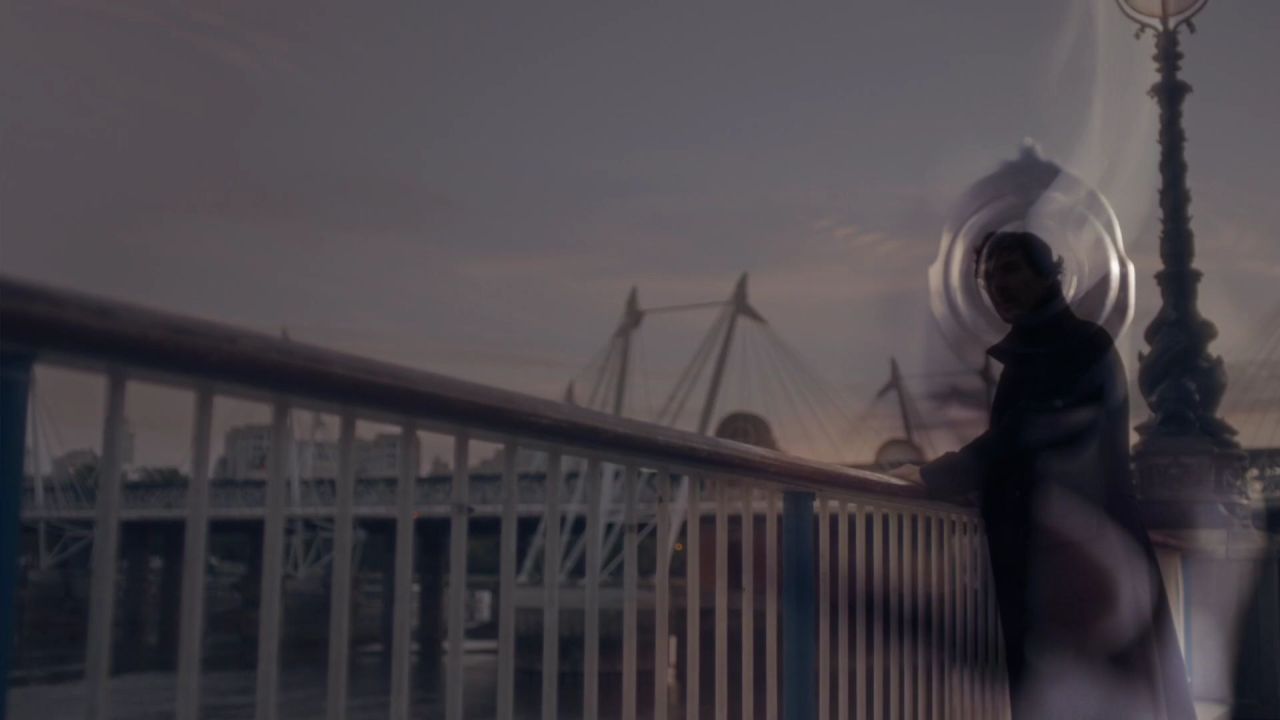
– second time during the scene of sherlock and faith talking at sunrise and the shot happens while sherlock says this:
SHERLOCK: “Taking your own life.” Interesting expression. Taking it from who? Oh, once it’s over, it’s not you who’ll miss it. (Resting
one hand on the railing, he looks westwards along the river towards the
London Aquarium. In a brief cut-away, a pistol fires towards the
camera, then there’s a brief shot of the exterior of the Aquarium as the
gunshot echoes and then smoke rises from the end of the pistol.
Sherlock now has both hands on the railing as he continues to gaze along
the river.) SHERLOCK: Your own death is something that happens to everybody else. (Faith has looked in the direction he’s looking but now turns to face him again. He lowers his head, his back to her.) SHERLOCK: Your life is not your own.(His voice becomes strained.)Keep your hands off it.
the gun is again linked to suicide idealization, suicide attempt and what would be the repercussion of killing yourself to the people you love. now we know that john has been deeply traumatized by sherlock’s fall. we see him being depressed, feeling suicidal and yet not wanting to end it this way. not 100%. he has one last hope: only sherlock could save him from dying, his life is not his own but sherlock’s… if sherlock wants him back.
– finally, the last shot, with eurus pointing it at john. we know eurus is an obvious john’s mirror but we also get the shot colored in red, à la james bond. sometimes in the narrative happened and john is on the verge of dying.
3 out of 3: the gun means john is dying and more probably by his own volition.
now whatever happening in s5, the reverse of asip would be quite interesting. one of the most iconic scenes of the show is after all john saving sherlock by shooting the cabbie, and we know the cabbie is a john’s mirror. sherlock saving john from a self-inflicted garridebs (of any kind) would close the circle.
‘save my life before my room i am lost without your love save my soul seek my room’ fcking hell
okay, so here’s my prediction. #thegameisnow is going to be an immersive AR game, starting in London and expanding from there, based on:
Niantic
See the pokeball and the clean line work from the Ingress symbol?
London will be the first ‘anomaly’ (any Ingress players out there?), this is where the story continues….
Hmmmmm this could be possible!! That way they wouldn’t have to rent out space for an actual escape room. And you wouldn’t have to somehow scramble together a trip to London to do it before some deadline. As long as the app exists, you can play
@gosherlocked I was reading the threads of your post of how drowning in BBC Sherlock is never the actual cause of death – if anything it’s a distraction. A red herring. Alex Woodbridge in TGG, The Dusty Death case in the beginning of TST, Carl Powers in TGG… Underwater is just where they go after something deadly has been administered.
But the original Sherlock Holmes didn’t drown either, even though it looked like it. Doyle threw him into the water in The Final Problem and everyone thought he drowned. Needless to say, I don’t think Victor Trevor actually drowned in The Final Problem. @shylockgnomes I believe is on the right track when they say Trevor is dead but died a different way. The “drowning” is just a second mask for the real death, like all the others were.
And considering all of the underwater imagery of series 4, I think it’s reasonable to argue series 4 IS Sherlock’s drowning. But he’s not really drowning, it’s just a cover up for something deadly that’s already been administered. Which would play back into @monikakrasnorada, yours, and my original EMP and possibly all of @sagestreet‘s wonderful analysis on a dying Sherlock.
Series 4 is a drowning. And it’s consistent to the other water “deaths” in BBC Sherlock. There’s first the real danger, then the corpse thrown underwater, then it’s recovered and the real danger is reassessed. Steps one, two, three. We watched Sherlock get shot (or fall off Bart’s, or shoot up cocaine after the wedding) and then we watched him drown himself in TAB by jumping off the waterfall. But the drowning has gone on so much longer than we would have ever guessed, which is why series 4 is BURSTING with drowning imagery and references.
Only step three is left – we gotta break through the watery red herring and assess the real cause of death. Which means we go backwards in time. Like with all the others. Like with the original The Final Problem/The Empty House.
I would like to issue a correction to everybody who says that Mary dies in the novels. There is no reference to what happens to her. There is only a reference to Dr. Watson’s sad loss. It doesn’t say she dies. Nowhere in those books does it say that Mary Morstan dies. So there.
something i find interesting about bbc sherlock is how mofftiss have actually changed the narrative so that sherlock is the central POV character rather than john
because acd’s canon is watson’s view on holmes, the audience is pre-programmed to think that we as spectators watching ‘sherlock’ align more closely with john, who is seen initially as an everyman, similarly ‘spectating’ sherlock and recording this as a blog
but within bbc sherlock, sherlock himself is really the main protagonist / POV character. we never get a complete picture of what john is thinking, yet we are consistently shown what’s going on in sherlock’s head.
i find it slightly humorous that john is seen as the ‘storyteller’ of the duo when really sherlock is the one to come up with lines such as “sentiment is a chemical defect found in the losing side”/”i may be on the side of the angels, but don’t think for one second that i am one of them”/”heroes don’t exist, john, and they did i wouldn’t be one of them” etc., in his usual dramatic fashion whereas the writing in john’s blog is … honestly not so good. what sherlock pretty much describes as ‘and then this happened, and then this happened, and then this’:
“So yes, we had a quick look at the flat and chatted to the landlady. Then the police came and asked Sherlock to look at a body so we went along to a crime scene, then we chased through the streets of London after a killer and Sherlock solved the serial suicides/murder thing.”
through TAB taking place within sherlock’s mind palace, sherlock essentially flips the script by having acd’s ‘victorian sherlock’ technically be sherlock’s reimagining of he and john’s adventures on the blog. so ACD’s sherlock holmes stories aren’t actually watson’s view on holmes, but sherlock’s view of john’s view on himself. gee whizz.
if you get really deep into this it means that all the logical inconsistencies and fallacies in ACD’s stories can actually be attributed to the unravelling of sherlock’s mind palace and the inconsistency of memory.




 Sherlock Fandom Archive